Kids' Winter Nosebleeds: Causes and What Parents Can Do
Most winter nosebleeds in kids come from dry air, colds and nose picking. Learn what causes them, how to stop one, and when to call a doctor.
The short version
- At least 60% of people in the United States have a nosebleed at some point, and only about 6% of them seek medical care.
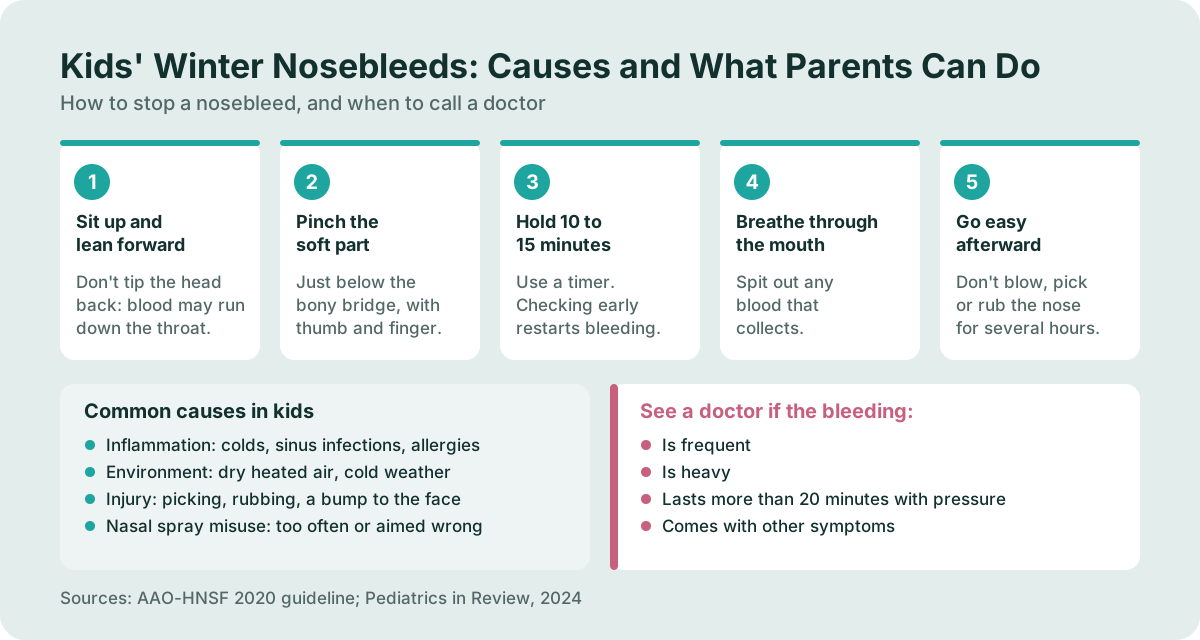
- In children, the usual causes are inflammation (such as colds and allergies), environmental factors like dry air, injury such as picking, and misuse of nasal medicines.
- Sitting up, leaning forward and pinching the soft part of the nose for 10 to 15 minutes stops most nosebleeds.
- Bleeding that is frequent, heavy, lasts more than 20 minutes with pressure, or comes with other symptoms needs a doctor's visit.
Nosebleeds are very common in children, and they tend to show up more when the weather turns cold. Most are harmless and come from the delicate lining at the front of the nose. Knowing the usual causes, a calm way to respond, and the warning signs makes them much less scary.
How common are nosebleeds, and are they normal in kids?
Yes. A 2020 clinical practice guideline from the American Academy of Otolaryngology-Head and Neck Surgery Foundation (pmid 31910111) says nosebleeds happen at some point in at least 60% of people in the United States. Only about 6% of people who have them seek medical attention.
That gap matters. Most nosebleeds are short and mild. The same guideline estimates that nosebleeds account for about 0.5% of all emergency department visits. A single bloody nose in a child is rarely a sign of something serious.
Why do kids get more nosebleeds in winter?
Winter nosebleeds mostly come from dry nasal lining, more colds, and more nose rubbing and blowing. The front of the nose has many tiny blood vessels close to the surface, and a dry, irritated lining cracks and bleeds easily.
Several winter habits stack up:
- Dry indoor air. Heating systems pull moisture out of the air. Cold outdoor air also holds little moisture to begin with.
- More colds. A stuffy, runny nose leads to frequent wiping and blowing. The lining swells and gets sore.
- Nose picking and rubbing. Fingernails scrape the same spot on the inner wall of the nose again and again.
- Allergies. Dust and indoor allergens can keep the lining inflamed and itchy.
A 2024 review of nasal disorders in children in Pediatrics in Review (pmid 38556515) lists the most common causes of nosebleeds as inflammatory, environmental and traumatic causes, plus medication misuse. Winter touches nearly all of these at once. This is a review article, not a single experiment, so it describes patterns doctors see rather than testing one cause.
What are the most common causes in children?
The most common causes are irritation and small injuries to the front of the nose, not serious disease. The table below groups them the way the pediatric review does and adds everyday examples.
| Cause group | Everyday examples |
|---|---|
| Inflammatory | Colds, sinus infections, allergies |
| Environmental | Dry heated air, cold weather |
| Traumatic | Nose picking, rubbing, a bump to the face, a toy or small object in the nose |
| Medication misuse | Nasal sprays used too often or aimed the wrong way |
One detail parents can control is nasal sprays. If a child uses a prescribed or store-bought nasal spray, ask the pediatrician to show how to aim it. The nozzle should point away from the middle wall of the nose, toward the outer corner of the eye on the same side. A spray aimed at the center wall can irritate it.
What should a parent do during a nosebleed?
Stay calm, sit the child up, lean them forward, and pinch the soft part of the nose for 10 to 15 minutes without letting go to check. This is standard first aid and works for most nosebleeds.
- Sit the child upright and tilt the head slightly forward. Do not tip the head back, because blood can run down the throat and cause gagging or vomiting.
- Pinch the soft part of the nose, just below the bony bridge, with the thumb and finger.
- Hold steady for 10 to 15 minutes. Use a timer. Checking early restarts the bleeding.
- Have the child breathe through the mouth and spit out any blood that collects.
- Afterward, ask the child not to blow, pick or rub the nose for several hours.
If the bleeding has not stopped after 15 minutes of firm pressure, repeat once. If it is still going after about 20 minutes total, get medical help.
How can parents lower the chances of winter nosebleeds?
Keep the nasal lining moist, keep little fingers away from it, and avoid irritants. None of these steps is a promise that bleeds will stop, but they remove the usual triggers.
Add moisture to the air and the nose
A cool-mist humidifier in the child's bedroom can help when indoor air is very dry. Keep the room humidity roughly between 30% and 50%, and clean the humidifier as the maker directs so mold and bacteria do not build up. Saline sprays or gels are a common gentle option for dry noses.
An oil-based nasal moisturizer is another choice for some families. Narisure is a nasal moisturizer that soothes and moisturizes dry nasal passages. Ask a pediatrician before using any nasal product in a young child.
Reduce irritation
- Trim fingernails short and teach gentle wiping instead of picking.
- Teach blowing one nostril at a time, softly.
- Treat allergy symptoms with a doctor's guidance, so the nose is not constantly itchy.
- Do not use nasal sprays more often or longer than directed.
Protect the nose from knocks
Helmets and sports gear matter in winter sports. A hard hit to the nose can cause a bleed or an injury that needs checking.
When are nosebleeds in kids a sign of something more serious?
Rarely, yes. The pediatric review notes that, uncommonly, children may have anatomic, blood-related (hematologic) or blood-vessel (vascular) problems, or even tumors in the nose and sinuses. These are not the usual explanation, but they are why doctors take repeated or unusual bleeding seriously.
Two examples show the range:
- Inherited blood-vessel disorder. Hereditary hemorrhagic telangiectasia (HHT) is an inherited condition in which fragile blood vessels cause repeated, spontaneous nosebleeds. The Second International Guidelines for HHT (pmid 32894695) set out how it is diagnosed and managed. A family history of frequent nosebleeds is one reason to mention the pattern to a doctor.
- Sinus symptoms that do not respond to antibiotics. A 2022 case report in Archives of Disease in Childhood: Education and Practice (pmid 32933929) described two teenage girls, aged 14 and 13. Both had what looked like sinusitis, with nosebleeds, and kept getting worse despite several antibiotic courses. Both later developed problems in other parts of the body and needed intensive care. They were then diagnosed with the same condition and recovered well. This was only two patients, so it says nothing about how often this happens. Its lesson is narrow: nosebleeds with a long illness that does not improve and new symptoms elsewhere deserve prompt medical review.
When should you see a doctor about a child's nosebleed?
See a doctor if nosebleeds are frequent, heavy, or hard to stop, or if they come with other worrying symptoms. A single short winter nosebleed usually does not need a visit.
Call a doctor or seek care if:
- Bleeding lasts more than 20 minutes despite correct pressure.
- The child has nosebleeds more than about once a week, or they keep coming back over several weeks.
- Bleeding is heavy, or the child looks pale, dizzy or unusually tired.
- Bleeding follows a significant blow to the head or face.
- The child bruises easily, has bleeding gums, or has blood in urine or stool.
- Bleeding happens from only one side every time, or there is a foul smell, a blocked nostril on one side, or a suspected object in the nose.
- Nosebleeds come with a long illness, fever, joint pain, weight loss, coughing blood, or sinus symptoms that do not improve with treatment.
- A parent or close relative has frequent nosebleeds or a known bleeding disorder.
Go to the emergency department for bleeding that will not stop, trouble breathing, or signs of heavy blood loss. Parents in New Jersey who want a specialist to look inside a child's nose can find nose and sinus doctors in New Jersey.
Common questions
Why does my child get nosebleeds only in winter?
Winter air, indoors and out, holds little moisture, so the nasal lining dries and cracks. Colds add blowing and wiping, and dry or itchy noses invite picking. Pediatric reviews list inflammation, environmental factors and minor injury as the most common causes. If bleeds are frequent or heavy, ask a doctor.
Should a child tilt their head back during a nosebleed?
No. Tilting the head back sends blood down the throat, which can cause gagging, coughing or vomiting. Have the child sit up, lean slightly forward, and pinch the soft part of the nose for 10 to 15 minutes without releasing. Seek care if bleeding lasts beyond about 20 minutes.
How often is too often for nosebleeds in kids?
There is no single number, but nosebleeds more than about once a week, or ones that keep returning over several weeks, should be checked. Heavy bleeding, easy bruising, or a family history of nosebleeds or bleeding disorders also call for a doctor's visit.
Can a humidifier help with a child's winter nosebleeds?
A cool-mist humidifier can ease dry indoor air, a common winter trigger, and room humidity of about 30% to 50% is a reasonable target. It will not stop every nosebleed. Clean it as directed to avoid mold, and still watch for frequent or heavy bleeding.
Sources
- Second International Guidelines for the Diagnosis and Management of Hereditary Hemorrhagic Telangiectasia. Annals of internal medicine, 2020
- Clinical Practice Guideline: Nosebleed (Epistaxis). Otolaryngology--head and neck surgery, 2020
- Sinister sinusitis. Archives of disease in childhood. Education and practice edition, 2022
- Nasal Disorders. Pediatrics in review, 2024
Articles are for general information, not medical advice. See a doctor for symptoms that are severe, persistent, or one-sided. Last updated October 31, 2026.