Dry Nose on Airplanes: Why Cabin Air Dries You Out
Cabin air is very low in humidity, which dries the nasal lining on flights. Learn why it happens, what helps, and when a nosebleed needs a doctor.

The short version
- Cabin air is usually reported at roughly 10 to 20 percent humidity, far drier than most homes, so the nasal lining loses moisture faster than it can replace it.
- Cabin pressure matters for your body, but it is the dry air, not the pressure, that dries your nose.
- Drinking water, rinsing with saline and adding a thin moisturizer layer before and during a flight are the simplest ways to stay comfortable.
- Most in-flight problems are minor, but a nosebleed that lasts more than 20 minutes of steady pressure needs help from the crew and a doctor.
A scratchy, tight, crusty nose is one of the most common complaints after a flight. The cause is the air inside the plane, which holds very little water. The good news is that a few simple habits can make a big difference.
Why does airplane air make my nose dry?
Cabin air is extremely dry, and the nose is the first place that air passes through. The thin lining inside your nose is wet by design. When the air around it holds almost no moisture, that lining dries out faster than it can refill.
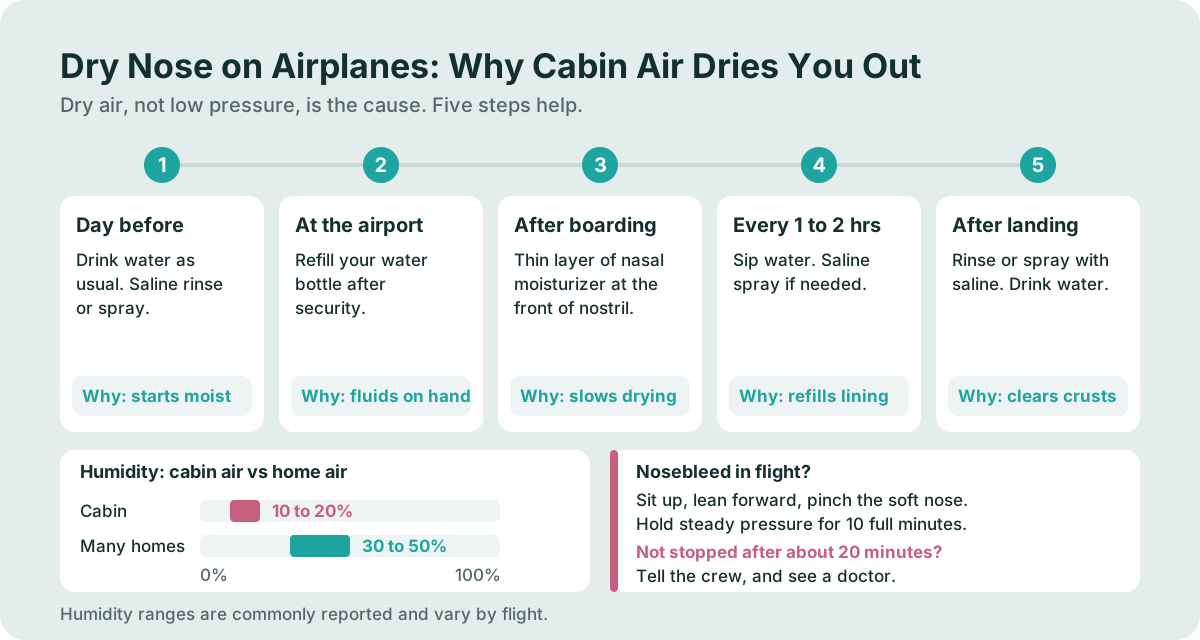
Planes pull in air from outside at cruising height. That air is very cold and holds almost no water. It is warmed and pumped through the cabin, but little moisture is added back. Cabin humidity is commonly reported at about 10 to 20 percent, though it varies by aircraft, flight length and how full the plane is. Many homes sit at 30 to 50 percent.
Your nose works as an air conditioner. It warms and humidifies every breath. In dry air, it has to work harder. Over a 3-hour or 10-hour flight, the lining can get dry, tight and irritated.
Does low cabin pressure dry out my nose?
No. Low pressure affects your body in other ways, but dryness comes from low humidity.
At cruising height, outside air pressure is far too low for people. Aircraft cabins are pressurized to deal with that. A review of high-altitude medicine by West (2012, American Journal of Respiratory and Critical Care Medicine) describes increasing barometric pressure, as in aircraft cabins, as one way to reduce the effects of low oxygen at altitude. The cabin is still kept at a pressure equal to a fairly high mountain altitude, which is why some people feel a little tired or have mild headaches on long flights.
That review is about oxygen and altitude illness. It does not measure nasal dryness. The link between cabin pressure and nasal comfort is not something it tests. The most reasonable explanation for a dry nose in flight is simple: dry air pulling water from a wet surface.
A separate StatPearls review (de la Cruz et al., 2024) covers decompression illness, which can happen with unpressurized flights, cabin pressure problems or flying soon after scuba diving. Its listed symptoms are joint pain, headaches, tingling and vision changes. These are not signs of a dry nose, and they are rare on normal commercial flights.
Who gets the driest nose on a flight?
Anyone can, but some people feel it sooner or more strongly.
- People who already have a dry nose from winter heating, CPAP use or frequent nose blowing
- People with nasal allergies, especially after using antihistamine or decongestant products that can dry the nose
- Anyone on a long flight, since dryness builds with time
- People who skip drinks or drink a lot of alcohol or coffee during the flight
- Anyone prone to nosebleeds, since dry lining cracks more easily
If you often have a dry nose at home, you will probably notice it more in the air.
What helps a dry nose on a plane?
The aim is to add moisture and to slow down moisture loss. No single step is magic, but together they help. The table sums up when to do what.
| When | What to do | Why it helps |
|---|---|---|
| Day before and morning of | Drink water normally, use a saline rinse or spray | Starts the trip with a moist lining |
| At the airport | Refill a water bottle after security | Easy access to fluids all flight |
| After boarding | Apply a thin layer of a nasal moisturizer | Creates a barrier that slows drying |
| Every 1 to 2 hours in flight | Sip water, use saline spray if needed | Replaces lost moisture |
| After landing | Rinse or spray with saline, drink water | Clears dried mucus and restores moisture |
Before you board
Drink water as usual. Do not try to flood yourself with water, because that does not directly moisten the nose. Staying well hydrated just keeps you from adding to the dryness.
A saline spray or gentle rinse before boarding loosens crusts and moistens the lining. Avoid medicated decongestant sprays unless a doctor told you to use them, since they can dry the nose and cause rebound congestion with repeated use.
During the flight
Small habits help:
- Sip water regularly. Ask the crew for a refill if needed.
- Use a saline spray every hour or two. Travel-size bottles fit the carry-on liquid limit.
- Use a thin layer of a nasal moisturizer. An oil-based nasal moisturizer such as Narisure is a nasal moisturizer that soothes and moisturizes dry nasal passages. A tiny amount is enough.
- Breathe through your nose when you can. Mouth breathing dries the throat and skips the nose's natural moistening.
- Avoid heavy alcohol and extra coffee, which can add to dehydration.
- Keep the overhead air vent turned away from your face.
What to skip
- Do not pick or dig at crusts. This can cause a nosebleed.
- Do not use petroleum-heavy products deep in the nose. Keep products at the front of the nostril unless the label says otherwise.
- Do not blow hard to clear dryness. Gentle blowing is safer.
Why do I get a nosebleed on a plane?
Dry air makes the nasal lining brittle. The front of the nose has many small blood vessels close to the surface, so a crack, a sneeze or a rub can cause bleeding. Most of these nosebleeds are minor.
If it happens:
- Sit up and lean slightly forward. Do not tip your head back.
- Pinch the soft part of the nose, just below the bone, with a tissue.
- Hold steady pressure for 10 full minutes without checking.
- Breathe through your mouth.
- Once it stops, do not blow your nose for several hours.
If it has not stopped after about 20 minutes of steady pressure, tell a flight attendant. A review of in-flight emergencies (Hu and Smith, 2021, American Family Physician) reports that 24 to 130 in-flight medical emergencies are estimated per 1 million passengers, and that up to 70 percent are handled by cabin crew without extra help. It also notes that all U.S. aircraft with at least one flight attendant and 30 or more seats carry an emergency medical kit. The review does not focus on nosebleeds, but it shows that crews are prepared to help.
For more detail on first aid, see our guide to stopping a nosebleed the right way.
How long does a dry nose last after a flight?
For most people, the dryness fades within a day or so after landing. Drinking water, using saline and sleeping in a room with comfortable humidity speed recovery. If you flew several times in a row, or arrived somewhere with dry or cold air, dryness may last longer.
A dry nose that stays for weeks, or gets worse, is probably not just from the flight. Other causes include winter heating, allergies, medicines or sleep devices.
What the research does and does not show
The studies reviewed for this guide cover altitude medicine, in-flight emergencies, decompression illness and cabin crew fitness. None of them measured nasal dryness in passengers or tested products for a dry nose in flight. So the advice above relies on how nasal lining works and on common medical guidance, not on a flight-specific trial. The humidity range given is a commonly reported figure and can vary.
When should I see a doctor?
Most dry noses after flights are harmless. See a doctor if:
- Nosebleeds happen often or last longer than 20 minutes with steady pressure
- Dryness, crusting or pain lasts more than 2 weeks after you are home
- You notice a lasting loss of smell
- You have one-sided blockage, bleeding or pus-like discharge
- You have facial pain, fever or swelling around the eyes
- You take blood thinners and have a nosebleed
Seek emergency care for heavy bleeding that will not stop, bleeding after a head injury, or trouble breathing.
If dryness or nosebleeds keep coming back, a specialist can look inside the nose and find the cause, and travelers in the area can find nose and sinus doctors in New Jersey.
Common questions
Why does my nose get so dry on a plane?
Cabin air has very little moisture, commonly reported at about 10 to 20 percent humidity. Your nose normally warms and moistens every breath, but dry air pulls water from the nasal lining faster than it can refill. The longer the flight, the more the dryness builds.
Can flying cause a nosebleed?
Yes, indirectly. Dry cabin air makes the nasal lining brittle, so a sneeze, rub or hard blow can cause a small bleed. Most are minor. Sit up, lean forward and pinch the soft part of your nose for 10 minutes. If bleeding lasts over 20 minutes, tell the crew.
Does drinking water fix a dry nose on a flight?
Water helps your overall hydration, but it does not directly moisten the inside of your nose. For better comfort, combine regular sips with a saline spray and a thin layer of nasal moisturizer. Also breathe through your nose and keep the air vent pointed away from your face.
Can I bring nasal spray on a plane?
Yes. Small saline sprays and nasal moisturizers are generally fine in a carry-on if each container fits the liquid limit, which is usually 3.4 ounces (100 ml) in the U.S. Pack them in your clear liquids bag. Check the rules of the airline and airport for your route.
Sources
- High-altitude medicine. American journal of respiratory and critical care medicine, 2012
- In-flight Medical Emergencies. American family physician, 2021
- Aerospace Decompression Illness
Articles are for general information, not medical advice. See a doctor for symptoms that are severe, persistent, or one-sided. Last updated November 1, 2026.