Why One Nostril Is Always Blocked: The Nasal Cycle Explained
One blocked nostril is usually the nasal cycle, a normal switch of swelling between sides. Learn why it happens, what's normal, and when to see a doctor.

The short version
- The nasal cycle is a normal, spontaneous switching of congestion and decongestion between the left and right sides of the nose.
- It happens because the turbinates inside the nose have a rich blood supply and can swell and shrink.
- A blocked side that never switches, or one that comes with pain, bleeding or smell loss, is not the nasal cycle and deserves a doctor visit.
- Decongestant sprays should not be used for more than about three days in a row, because the stuffiness can rebound.
Most people think both nostrils work the same all day. They do not. One side usually carries more air, and the busy side changes over time. This normal pattern is called the nasal cycle, and it explains why one nostril so often feels blocked.
What is the nasal cycle?
The nasal cycle is a spontaneous alternation of congestion and decongestion between the left and right sides of the nose. One side gets a little swollen and narrow while the other opens up. Later, they trade places.
A StatPearls review on nasal physiology (Freeman and colleagues, 2023) lists the nasal cycle as part of normal nose function. The same review describes the nose as more than an air pipe. It warms and humidifies air, helps with smell, and acts as part of the body's immune defense. The nasal cycle is one piece of that system.
Why does one nostril get blocked and not the other?
One side swells because the tissue inside it fills with blood. Each side of the nose is divided by three shelf-like structures called turbinates. According to the StatPearls review, the turbinates are rich in glands and have an abundant blood supply. When the blood vessels in the turbinates on one side expand, the tissue puffs up and air has less room to pass. On the other side, the vessels shrink and the airway widens.
The swelling has nothing to do with mucus. Many people blow their nose when a side feels blocked, but nothing comes out. That is a clue the problem is swollen tissue, not a plug.
Is the nasal cycle normal?
Yes. It is a healthy, built-in pattern, and most people never notice it. You tend to notice it when you have a cold, allergies or dry air, because any extra swelling makes the narrow side feel much worse.
The total airflow through both nostrils stays fairly steady. When one side closes a bit, the other opens. So you are not breathing less overall. You are just feeling one side more than the other.
How often the sides switch varies from person to person. It is often described as a matter of hours, and it can change with posture, activity and time of day. Exact timing is not something to track or worry about.
How long does each side stay blocked?
There is no single schedule. For many people, the sides trade places every few hours, but the pattern can be uneven and it is easy to miss. The provided research describes the alternation as spontaneous, with no fixed timing.
Some things can change the pattern:
- Lying on your side. The lower nostril often gets more stuffy. Flip over and the sides may swap within minutes.
- Exercise. Hard activity tends to shrink swollen nasal tissue for a while.
- Colds and allergies. Swelling from inflammation adds to the natural cycle, so both sides can feel worse.
- Dry or irritating air. Dryness and irritants can make the lining feel crusty or uncomfortable, which adds to the feeling of blockage.
Why is my nose more blocked when I lie down?
Lying down often makes the effect stronger. Blood flow in the head changes with position, so the nasal tissue can swell a little more. When you lie on one side, the lower nostril tends to close up and the upper one opens.
This is why a nose that felt fine at dinner can feel stuffed at bedtime. Rolling over usually helps. Sleeping with your head slightly raised can also help some people.
Does the nasal cycle affect the brain?
Breathing through the nose does appear to matter for the brain, but the nasal cycle itself is not shown to change thinking or mood in healthy people.
A 2016 study in The Journal of Neuroscience (Zelano and colleagues) recorded brain activity directly in people with epilepsy who already had electrodes placed for medical reasons. Natural breathing synchronized electrical activity in the olfactory (smell) cortex and in limbic areas, including the amygdala and hippocampus. The effect peaked during inhalation and faded when breathing was switched from the nose to the mouth. In separate tests with healthy volunteers, the breathing phase affected fear discrimination and memory retrieval.
There are limits. The brain recordings came from a rare group of patients with epilepsy, so the results may not match everyone. The study looked at nose versus mouth breathing, not at left versus right nostril. It does not show that a blocked nostril changes how you think.
A 2015 report in Psychiatry Research (Shannahoff-Khalsa and Golshan) is even more limited. It followed one woman with schizophrenia over 1,086 days and found that left-nostril dominance was more common at the start of her 145 hallucination episodes. A single case cannot show cause and effect, and it says nothing about ordinary people. Nobody should use nostril breathing exercises as a replacement for mental health care.
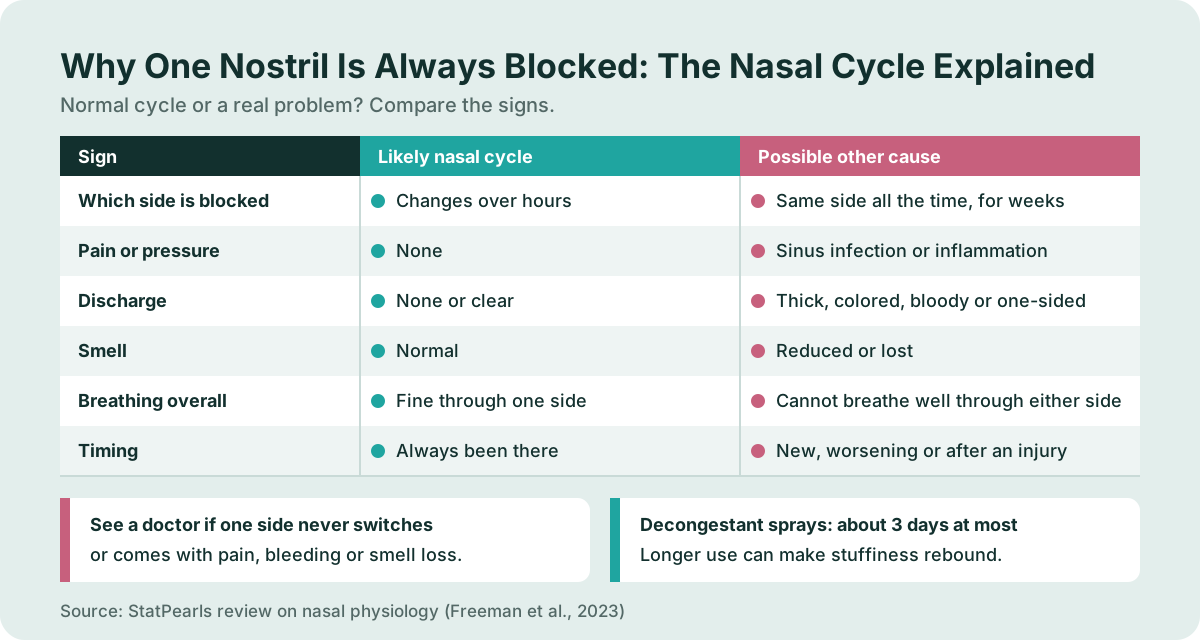
Nasal cycle or a real problem: how can you tell?
A normal nasal cycle shifts sides and comes with no other symptoms. A structural or medical problem tends to stay put or bring other signs.
| Sign | Likely nasal cycle | Possible other cause |
|---|---|---|
| Which side is blocked | Changes over hours | Same side all the time, for weeks |
| Pain or pressure | None | Sinus infection or inflammation |
| Discharge | None or clear | Thick, colored or bloody, or from one side only |
| Smell | Normal | Reduced or lost |
| Breathing overall | Fine through one side | Cannot breathe well through either side |
| Timing | Always been there | New, worsening or after an injury |
Common causes of a side that stays blocked include a deviated septum (a crooked wall between the nostrils), nasal polyps, long-term swelling of the nasal lining from allergies, and a swollen turbinate. These are real conditions, but only an exam can sort them out.
What can ease a stuffy side?
If the blockage is just the cycle, it usually passes without help. These simple steps are safe for most people:
- Change position. Roll to the other side or raise your head.
- Rinse with saline. Use a saline spray or rinse. If you make a rinse at home, use distilled, sterile or previously boiled and cooled water, never straight tap water.
- Add moisture. Warm shower steam or a comfortable level of indoor humidity can make the nose feel less tight.
- Stay active. A brisk walk often opens the nose for a while.
- Be careful with decongestant sprays. Medicated sprays can shrink swollen tissue fast, but using them for more than about three days in a row can cause rebound congestion that is worse than the original stuffiness. Check the label and ask a pharmacist or doctor if unsure.
Taping, clips and other gadgets are not needed for a normal nasal cycle.
When should you see a doctor?
See a doctor if one side stays blocked for weeks, or if blockage comes with other symptoms. A normal nasal cycle alternates and does not hurt.
Book a visit for any of these:
- One nostril blocked all the time for more than a few weeks
- Repeated nosebleeds from the same side
- Thick yellow or green discharge, facial pain or pressure, or fever lasting more than about 10 days
- Loss or major change in sense of smell
- Blockage after a nose injury
- Trouble breathing through the nose that disrupts sleep or daily life
- A decongestant spray that you feel you cannot stop using
Get urgent care for a nosebleed that does not stop after 15 to 20 minutes of steady pressure, or for a stiff neck, vision changes, or swelling around the eye with a nasal infection.
If a blocked nostril keeps coming back and you want an exam of the nasal passages, you can find nose and sinus doctors in New Jersey who can check for a deviated septum, swollen turbinates or other causes.
Common questions
Why is one nostril always blocked?
Most often it is the nasal cycle, a normal alternation of swelling between the left and right sides of the nose. Blood fills the turbinates on one side and narrows the airway, then the sides swap. If the same side stays blocked for weeks, a deviated septum, polyps or allergies may be the cause.
How often does the nasal cycle switch sides?
It varies by person. For many people the sides trade places every few hours, but there is no fixed schedule. Position, exercise, colds and allergies can change the pattern. Because the other side opens as one closes, total airflow stays fairly steady.
Why does my nose block on the side I sleep on?
When you lie on one side, blood pools in the lower side of the nose and the tissue swells, so the lower nostril feels stuffier. Rolling onto the other side often switches it within minutes. Raising your head a little with an extra pillow can also help.
Is it bad if I can only breathe through one nostril?
Not if the open side changes over time. That is the normal nasal cycle. See a doctor if the same side stays blocked for weeks, if you also have pain, bleeding or smell loss, or if you cannot breathe well through either side.
Sources
- Physiology, Nasal
- Nasal Respiration Entrains Human Limbic Oscillations and Modulates Cognitive Function. The Journal of neuroscience, 2016
- Nasal cycle dominance and hallucinations in an adult schizophrenic female. Psychiatry research, 2015
Articles are for general information, not medical advice. See a doctor for symptoms that are severe, persistent, or one-sided. Last updated October 31, 2026.