Nasal Irrigation for Sinus Symptoms: What the Studies Show
Nasal saline irrigation may ease allergy and sinus symptoms, but the evidence is small and low quality. Here is what three studies found, and their limits.

The short version
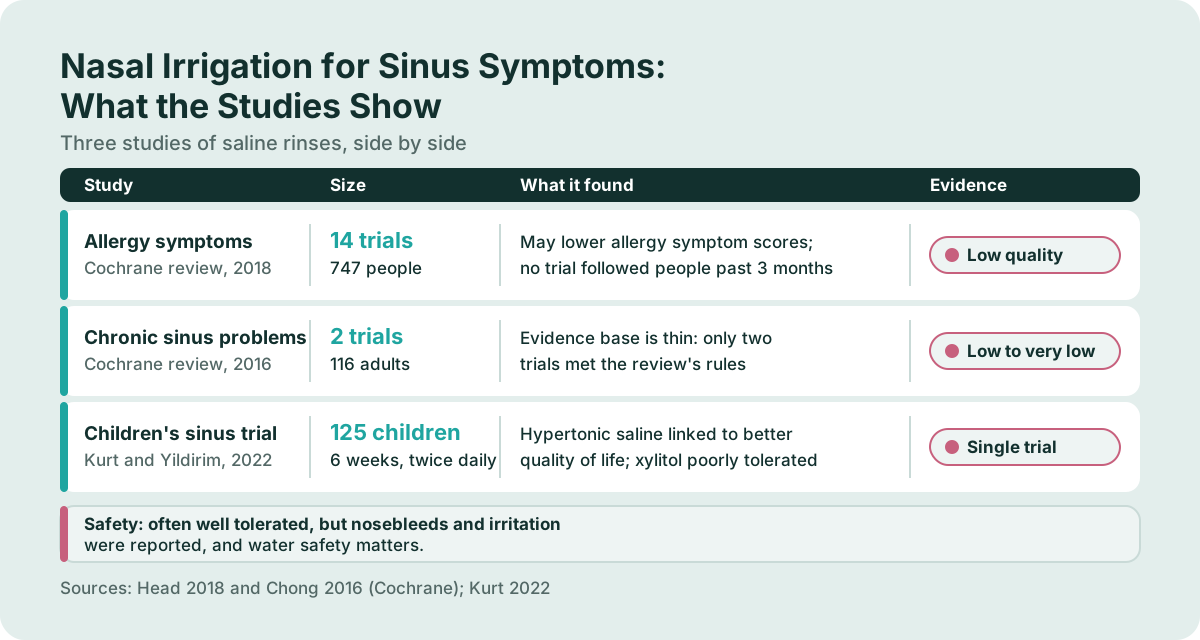
- A Cochrane review of 14 trials (747 people) found saline irrigation may lower allergy symptom scores, but the evidence was rated low quality and no trial followed people beyond three months.
- For chronic sinus problems, a Cochrane review could include only two trials (116 adults), so the evidence base is thin.
- In one trial of 125 children with chronic rhinosinusitis, twice-daily hypertonic saline for 6 weeks was linked to better quality-of-life scores, while saline with xylitol was poorly tolerated.
- Irrigation is commonly used and often well tolerated, but nosebleeds and irritation were reported, and water safety matters.
Nasal irrigation means rinsing the inside of the nose with salty water. It is one of the most common home steps for stuffy, runny or congested noses. This digest looks at three studies on how well it works for allergies and long-lasting sinus symptoms.
What is nasal irrigation, and why do researchers study it?
Nasal irrigation is a rinse of the nasal passages with saline (salty water), delivered by a squirt bottle, pump, spray, nebuliser or gravity-fed pot. The idea is simple: rinsing may wash out mucus, allergens and debris, so the nose feels clearer.
Researchers compare different versions. Isotonic saline has about the same saltiness as body fluids. Hypertonic saline is saltier. Volume also varies, from a light spray to 150 ml rinses. The studies below use different versions, so their results cannot be lumped together neatly.
What did the Cochrane review find for allergic rhinitis?
The review suggests saline irrigation may reduce allergy symptom severity, but the evidence is low quality. Allergic rhinitis is the stuffy, sneezy, itchy-nose problem often called hay fever.
How the review was done
A Cochrane team (Head and colleagues, 2018) searched medical databases up to 23 November 2017. They included randomised controlled trials of saline irrigation, in adults and children with allergic rhinitis. Some trials compared saline with no saline. In others, everyone also used medicines such as nasal steroid sprays or antihistamines.
They found 14 studies with 747 participants:
| Group | Studies | Participants |
|---|---|---|
| Children | 7 | 499 |
| Adults | 7 | 248 |
No study followed people beyond three months.
What it found
The studies used different symptom scoring systems. The team pooled them with a standardised mean difference (SMD), a way to put different scales on one common scale. Here, a more negative number means lower symptom severity.
- Up to four weeks: SMD -1.32 (95% confidence interval -1.84 to -0.81), based on 6 studies and 407 participants. Quality: low.
- Four weeks to three months: SMD -1.44 (95% CI -2.39 to -0.48). Quality: low.
In statistics, numbers this size are usually called large effects. The authors' wording was careful, though: saline irrigation "may improve" symptoms. The low-quality rating means future studies could change the picture.
Limits
The seven studies of saline versus no saline used different scoring systems, volumes and solutions. People usually know whether they are rinsing, which can shape how they rate symptoms. Nothing was tracked past three months. The review also cannot say which method, volume or saltiness works best.
What did the Cochrane review find for chronic rhinosinusitis?
Very little can be concluded, because only two trials met the review's rules. Chronic rhinosinusitis (CRS) is long-lasting swelling of the nose and sinus lining, with blockage, discharge, facial pressure and often a weaker sense of smell.
How the review was done
Chong and colleagues (2016) searched up to 30 October 2015. They accepted only randomised trials with at least three months of follow-up. That strict rule left two trials with 116 adults in total.
- Trial 1: 76 adults (52 in the saline group, 24 in the control group), with or without nasal polyps. The saline group used large-volume (150 ml), hypertonic (2%) saline irrigation. The control group had usual treatment. It ran six months.
- Trial 2: the remaining 40 adults compared 5 ml of nebulised saline twice a day with nasal corticosteroids. Treatment lasted three months, with a check at the end and another three months later.
What it found in Trial 1
Quality of life was measured with the Rhinosinusitis Disability Index, scored 0 to 100, where 100 is best.
| Time point | Difference vs. control | 95% CI | Evidence quality |
|---|---|---|---|
| 3 months | 6.3 points better | 0.89 to 11.71 | Low |
| 6 months | 13.5 points better | 9.63 to 17.37 | Very low |
The other symptom measure in this trial could not be interpreted, because the score range was not stated. Side effects were not recorded in the control group. In the saline group, 23% had side effects, including nosebleeds.
Limits
One trial of 76 people is a small base. The evidence was rated low or very low quality. Because side effects were recorded in only one group, the real rate of nosebleeds and irritation compared with no rinsing is unknown. Results from this trial also cannot be assumed to apply to other volumes or to saline sprays.
What did the pediatric trial of hypertonic saline and xylitol find?
In 125 children with chronic rhinosinusitis, twice-daily hypertonic saline for 6 weeks was linked to better quality-of-life scores. Adding xylitol did not help, and children tolerated it poorly.
How it was done
This 2022 study by Kurt and Yildirim was prospective, randomised and single-blinded. All 125 children had a CRS diagnosis. They were randomly assigned to twice-daily hypertonic irrigation with either plain saline or saline plus xylitol, a sugar alcohol. Parents or children filled in the Sinonasal Quality of Life Survey (SN-5) at the start and after 6 weeks.
What it found
In the hypertonic saline group, scores improved in four SN-5 domains, and the overall quality-of-life score rose. Activity limitation did not change significantly (p = 0.1803). The xylitol arm did not show differences in SN-5 scores. The authors said xylitol had low tolerance, poor compliance and side effects, and did not recommend it as a first-line choice. They concluded that large-volume, low-pressure hypertonic irrigation twice daily for 6 weeks was safe and effective, and could be a baseline treatment before surgery is considered.
Limits
The available summary compares two kinds of irrigation. It does not describe a group that did no irrigation. Children with CRS often change from week to week, so some improvement could come from time passing. The study lasted 6 weeks. Quality-of-life surveys rely on reports from children and families. The authors' wording, "safe and effective," is stronger than this design can fully support.
What do these studies mean for readers?
Saline irrigation has reasonable support as a low-cost option that may ease symptoms, especially for allergies. Evidence for chronic sinus problems is thinner.
Practical points that match the studies:
- Expect modest, not dramatic, change. The best evidence says "may improve," with low-quality ratings.
- Consistency may matter. The positive trials used regular, often twice-daily routines over weeks.
- Watch for side effects. Nosebleeds and local irritation were reported in the CRS trial.
- Use safe water. General public-health guidance says to use distilled, sterile or previously boiled and cooled water, and to clean and air-dry the device after each use. Untreated tap water can carry germs.
- Skip xylitol rinses for children for now. The one trial found poor tolerance.
What can these studies not tell us?
They cannot say which type of irrigation is best, whether it prevents flare-ups over many months, or whether it is better than steroid sprays. The allergy review followed people for three months at most. The CRS review found only two trials. The children's trial ran six weeks. Nothing here covers babies or long-term daily use.
When should you see a doctor about sinus symptoms?
See a doctor if symptoms last more than 10 days without improving, or keep returning. A nose that stays blocked for 12 weeks or more may be chronic rhinosinusitis and needs a proper exam.
Get medical care promptly for:
- Fever with thick discharge and facial pain
- Swelling or redness around the eyes
- Vision changes or a severe headache
- Repeated or heavy nosebleeds
- Loss of smell that does not return
- Symptoms in a baby or young child that do not improve
Rinsing should not replace an exam when these signs appear. Readers who want an in-person evaluation can find nose and sinus doctors in New Jersey for persistent congestion or sinus problems.
Common questions
Does nasal irrigation really work for sinus problems?
It may help, but the evidence is limited. A Cochrane review of 14 trials found saline irrigation may lower allergy symptom scores, rated low quality. For chronic sinusitis, a separate review found only two trials with 116 adults. Results look promising, but they are not strong enough to call it a proven fix.
Is hypertonic or isotonic saline better for sinus symptoms?
The studies reviewed cannot say. Hypertonic saline (saltier) was used in the adult CRS trial and the 125-child trial, with improved quality-of-life scores. The allergy review included both types but did not name a winner. No direct comparison here shows one is better, so comfort and doctor advice matter.
Does nasal irrigation cause nosebleeds?
It can in some people. In the one chronic rhinosinusitis trial the Cochrane review described, 23% of the saline group reported side effects, including nosebleeds. Side effects were not recorded in the control group, so the true added risk is unclear. Frequent or heavy bleeding is a reason to stop and see a doctor.
Is xylitol nasal irrigation good for children?
One 2022 trial of 125 children with chronic rhinosinusitis did not support it. The authors reported low tolerance, poor compliance and side effects with xylitol, and did not recommend it as a first-line choice. Hypertonic saline alone was linked to better quality-of-life scores after 6 weeks. A pediatrician can advise on safe options.
Sources
- Saline irrigation for allergic rhinitis. The Cochrane database of systematic reviews, 2018
- Saline irrigation for chronic rhinosinusitis. The Cochrane database of systematic reviews, 2016
- Effectiveness of pediatric nasal irrigation solution with or without xylitol. International journal of pediatric otorhinolaryngology, 2022
Articles are for general information, not medical advice. See a doctor for symptoms that are severe, persistent, or one-sided. Last updated November 3, 2026.