Smell Loss After COVID: What Affects Recovery, per Research
Most people regain smell within weeks, but up to 7% still have none after a year. Here is what recent reviews say about risk factors and recovery options.

The short version
- Many people regain smell within two to four weeks of COVID-19, but a significant minority do not.
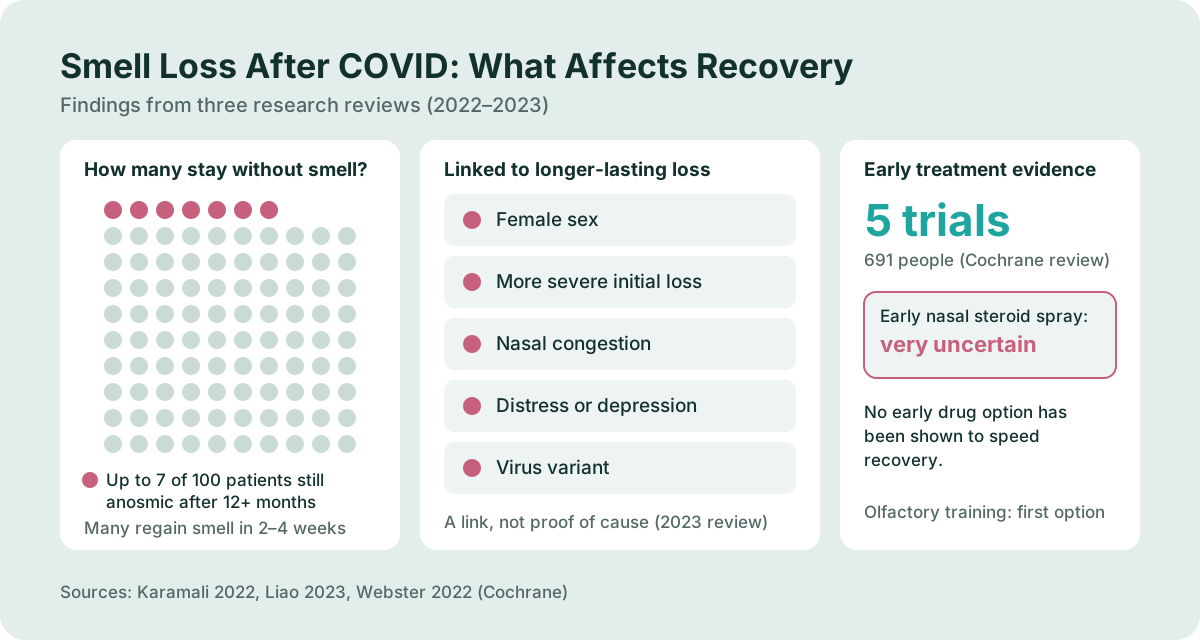
- A 2022 review reports that up to 7% of patients were still anosmic (no sense of smell) more than 12 months after onset.
- A 2023 review links longer-lasting smell loss to female sex, a more severe initial loss, nasal congestion, emotional distress or depression, and the virus variant.
- A Cochrane review of 5 trials with 691 people found the evidence on early nasal steroid sprays very uncertain, so no early drug option has been shown to speed recovery.
Losing the sense of smell is one of the most common symptoms of COVID-19. For most people it returns quickly. For some it lingers for months or longer. Three recent reviews help explain how common long-lasting smell loss is, who is more likely to have it, and what the evidence says about recovery options.
How many people stay without smell after COVID-19?
Most people recover, but a small share do not. A 2022 review by Karamali, Elliott and Hopkins (PMID 34889850) reports that up to 7% of patients were still anosmic, meaning unable to smell, more than 12 months after onset. The authors say this leaves millions of people worldwide with severe smell loss.
How the review was done
This was a narrative review in Current Opinion in Otolaryngology & Head and Neck Surgery. The authors did not run a new experiment. They read the existing literature on how common the problem is, why it happens, how often people recover, and which options exist. Narrative reviews give a useful overview. They do not follow the strict search rules of a systematic review, so they can miss studies.
What it found
- Smell loss was among the most commonly reported symptoms after COVID-19 infection.
- Self-reported recovery rates were high.
- Even so, up to 7% remained anosmic past 12 months.
- Olfactory training was named as the first recommended option, and few effective medical options exist.
The review notes that recovery rates are often self-reported. People are not always tested with scented items, so the true numbers may differ. The phrase "up to 7%" is also an upper figure, not an average across all patients.
What raises the risk of smell loss that lasts?
A 2023 review (PMID 36574210) names several risk factors. These are female sex, a more severe initial loss of smell, nasal congestion, emotional distress and depression, and the SARS-CoV-2 variant. The pattern is a link, not proof of cause.
How the review was done
Liao, Deng, Zeng and Liu, from Tongji Hospital in Wuhan, China, wrote a narrative review in Current Allergy and Asthma Reports. It covers loss of smell and loss of taste in long COVID. It looks at how common they are, risk factors, possible mechanisms and possible therapies.
What it found
| Question | What the review reports |
|---|---|
| Do most people improve? | Smell and taste improved in over 60% of patients in a short time after the acute infection. |
| Does it last for some? | A considerable number still had problems 3 months to 2 years after symptoms began. |
| Is it getting less common over time? | Prevalence kept declining after the acute illness. |
| What predicts lasting problems? | Female sex, severe initial loss, nasal congestion, emotional distress and depression, and the variant. |
| Is the cause known? | No. The review says it remains unknown, but it may resemble lasting smell loss after other common respiratory viruses. |
Two points deserve care. First, emotional distress and depression appear on the list, but the review does not say which comes first. Losing smell can itself cause distress, so the link may run both ways. Second, nasal congestion as a risk factor suggests that blockage inside the nose may play some role for some people. The review does not explain how.
Do any early options help smell come back?
So far, no early drug option has clear support. The strongest evidence is a Cochrane systematic review (PMID 36063364), and it found the evidence very uncertain.
How the review was done
Webster and colleagues updated a living Cochrane review in 2022. They searched several research databases, plus trial registers, for randomised controlled trials. The last search was on 20 October 2021. Trials had to include people whose COVID-19 smell problem had lasted less than four weeks. Any intervention could be compared with no treatment or placebo. The team rated how certain the evidence was using the GRADE system.
What it found
- Five studies with 691 participants were included.
- The interventions were nasal steroid sprays, nasal steroid drops, nasal hypertonic saline (a salt solution stronger than body fluids) and zinc sulphate.
- Three of the studies, with 288 participants, tested steroid spray.
- For steroid spray, the evidence was "very uncertain" about whether it helped people recover smell within up to four weeks.
- In one 100-person study, self-rated recovery had a risk ratio of 1.19, with a 95% confidence interval of 0.85 to 1.68.
That interval matters. A risk ratio of 1 means no difference. The range runs from below 1 to well above it, so the result is compatible with a small harm, no effect or a moderate benefit. The data cannot tell which.
The review also states a key background fact. For many people the smell problem is temporary and resolves within two to four weeks. That makes it harder to show that any early option works, because many people recover with no help at all.
What about olfactory training?
Olfactory training is the option both Karamali and colleagues and Liao and colleagues point to. Karamali's review calls it the first recommended option. Liao's review calls it, along with corticosteroids, a potential choice for lasting smell loss, but says more studies are needed to prove it.
In general, olfactory training means sniffing a small set of strong, distinct scents on purpose, usually twice a day, for several months. Commonly used scents include rose, lemon, eucalyptus and clove. The idea is to give the smell system regular practice. The details above come from general practice, not from the three reviews. The reviews do not give a schedule or success rate in the text available here.
What these studies cannot tell us
These reviews are helpful, but they leave real gaps:
- They summarise other studies. They are not new trials, so their conclusions depend on the quality of the underlying work.
- Self-reported recovery can be off. People may over- or under-estimate how well they smell.
- Risk factors are links, not causes. Being female or having depression does not mean smell will fail to return.
- The cause is not settled. Liao's review says the mechanism in long COVID is unknown.
- Early options are unproven. The Cochrane review covers only trials of people within four weeks of onset, and it found very uncertain evidence for steroid spray.
- The picture may change with variants. Liao's review lists the variant as a risk factor, so older figures may not match newer infections.
What this means for readers
If smell is gone after an infection, waiting a few weeks is reasonable, since many people improve in two to four weeks. Safety matters too. People without smell cannot detect gas leaks, smoke or spoiled food as easily, so working smoke and gas detectors and checking expiry dates help.
Because olfactory training is the first-line option named in the reviews, it is worth asking a clinician about it. Decisions about steroid sprays, drops or other medicines are best made with a doctor, since the evidence is uncertain.
When to see a doctor
Book a visit if smell has not started to return after about four weeks, or if it gets worse. See a doctor sooner if loss of smell comes with one-sided blockage, bloody discharge, severe facial pain, vision changes, a stiff neck, high fever or a head injury. Smell that returns distorted, such as a bad smell from normal food, is also worth mentioning. A clinician can check for other causes, such as sinus disease or nasal polyps, and discuss options. People in New Jersey can find local care through this list of nose and sinus doctors in New Jersey.
Common questions
How long does loss of smell last after COVID-19?
For many people it resolves within two to four weeks, according to a Cochrane review. A 2022 review reports that up to 7% were still anosmic more than 12 months after onset. A 2023 review found some patients had problems 3 months to 2 years later.
Who is more likely to have long-lasting smell loss?
A 2023 narrative review lists female sex, a more severe initial loss, nasal congestion, emotional distress and depression, and the virus variant as risk factors. These are links found in the research, not proof of cause, and they cannot predict any one person's recovery.
Do nasal steroid sprays help smell return after COVID-19?
Unclear. A Cochrane review of three trials with 288 people found the evidence very uncertain for steroid spray used within four weeks of onset. In one 100-person study, the confidence interval for self-rated recovery ran from 0.85 to 1.68, which includes no effect.
What is olfactory training?
It is a practice of deliberately sniffing a few strong scents, often twice daily for months, to give the smell system regular exercise. Two reviews name it as a first-line or potential option for lasting smell loss, though one says more studies are needed.
Sources
- COVID-19 related olfactory dysfunction. Current opinion in otolaryngology & head and neck surgery, 2022
- Long-term Consequences of COVID-19: Chemosensory Disorders. Current allergy and asthma reports, 2023
- Interventions for the prevention of persistent post-COVID-19 olfactory dysfunction. The Cochrane database of systematic reviews, 2022
Trusted resources
From our sister sites
Coastal SinusChronic Sinusitis: Symptoms, Causes and the 12-Week RuleChronic sinusitis means sinus symptoms lasting 12 weeks or more, plus proof of inflammation. Learn the symptoms, causes, tests and treatment options.NJ Sinus & AllergyDo HEPA Air Purifiers Help Allergies? What Trials FoundHEPA air purifiers may ease some allergy symptoms, but results are mixed. Here is what two trials and a Cochrane review found, and what they miss.Articles are for general information, not medical advice. See a doctor for symptoms that are severe, persistent, or one-sided. Last updated November 11, 2026.