Indoor Humidity and Respiratory Infections: What New Research Shows
Dry indoor air may let virus droplets linger and slow nasal mucus clearing. Here is what three recent studies found, and what they cannot prove.

The short version
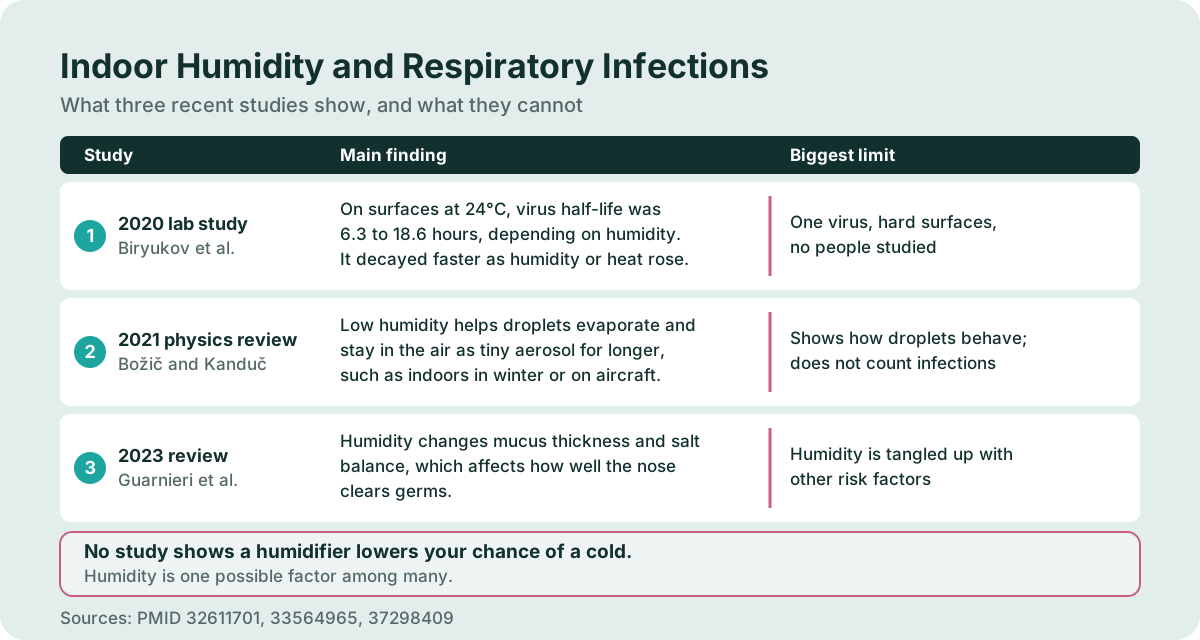
- In a 2020 lab study, SARS-CoV-2 on surfaces at 24°C had a half-life of 6.3 to 18.6 hours depending on humidity, and it decayed faster as humidity or temperature rose.
- A 2021 physics review explains that low humidity, such as indoors in winter or on aircraft, helps droplets evaporate and stay in the air as tiny aerosol for longer.
- A 2023 review says humidity changes the thickness and salt balance of nasal mucus, which affects how well the nose clears germs.
- None of these studies show that running a humidifier lowers a person's chance of catching a cold, so humidity is one possible factor among many.
Winter is cold and flu season, and it is also the season of dry indoor air. That overlap has made researchers ask whether the humidity in a room changes how easily respiratory viruses spread and how well the nose defends itself. Three research papers give a useful picture, and they also show where the evidence stops.
Does indoor humidity affect respiratory infections?
Possibly, in two ways: humidity may change how long viruses survive and travel, and it may change how well the nose clears them. The research so far comes mostly from lab experiments and reviews, not from trials that test whether changing humidity in homes prevents illness in people.
Relative humidity (RH) is the amount of water vapor in the air compared with the most the air could hold at that temperature. A reading of 40% means the air holds 40% of its maximum. Cold outdoor air holds little water. When it is heated indoors, RH often drops very low.
How was the 2020 surface study done, and what did it find?
A team at a U.S. biodefense research center dried SARS-CoV-2 onto surfaces in a lab and measured how fast it lost its ability to infect (PMID 32611701). The virus broke down faster when humidity or temperature went up.
The details:
- Design: Laboratory experiment. The virus was mixed into a simulated clinically relevant matrix, dried on nonporous surfaces, and tested at different humidity levels and temperatures.
- Surfaces and droplet sizes: Stainless steel, plastic and nitrile glove material. Droplets ranged from 1 to 50 microliters.
- Main result: At room temperature (24°C), the virus half-life ranged from 6.3 to 18.6 hours depending on humidity. At 35°C, it dropped to a range of 1.0 to 8.9 hours.
- What did not matter much: Droplet size and surface type did not significantly change the decay rate.
A half-life is the time it takes for half of the virus to become inactive. The authors concluded that the chance of spread from contaminated surfaces could last for hours to days indoors.
Limits: This was one virus, on hard surfaces, in a controlled lab. It did not study people, air, or real homes. It also says nothing about colds caused by other viruses.
What does the 2021 review say about droplets in dry air?
A physics review of how respiratory droplets behave (PMID 33564965) explains that low humidity helps droplets shrink and stay airborne. The authors noted that this happens indoors in winter and inside aircraft.
When you breathe out, talk or cough, you release droplets of different sizes. Big droplets usually fall quickly. In dry air, though, water evaporates from them faster. The review says that low RH "keeps even initially large droplets suspended in air as aerosol for extended periods of time." Smaller particles float longer and can travel farther in a room.
The review also looked at how humidity affects virus stability inside those droplets, through processes such as efflorescence (salts drying into crystals) and inactivation at the air-water boundary. The authors said the role of these processes in killing viruses is still poorly understood.
Limits: This is a review of physical principles, not a study of sick people. It shows how droplets behave. It does not measure how many infections happen at a given humidity.
How does humidity affect the nose's own defenses?
A 2023 review from Italian researchers (PMID 37298409) says humidity mainly acts on mucus. It changes how thick the mucus is and its salt concentration (osmolarity), which changes how well tiny hairlike cilia sweep it out of the nose.
The nose is lined with a thin layer of mucus that traps dust, germs and irritants. Cilia move that layer toward the throat, which is called mucociliary clearance. The authors also point to the physical barrier made of mucus and tight junctions between cells, which helps keep pathogens and irritants out. Air that is too dry or too humid can disturb this system.
The review also makes an honest point. Poor humidity often comes along with other problems, such as irritants, allergens and pathogens. So the effect of humidity alone is hard to separate. The authors suggest humidity may add to the harm from those other factors, and that normalizing it, where possible, could help create a healthier environment.
Limits: This is a narrative review. It brings together mechanisms and past research but does not provide a new measurement of infection rates.
How do the three papers compare?
| Paper | Type | Main finding | Biggest limit |
|---|---|---|---|
| Biryukov et al., 2020 (PMID 32611701) | Lab experiment | SARS-CoV-2 on surfaces decayed faster at higher humidity or temperature | One virus, hard surfaces, no people |
| Božič and Kanduč, 2021 (PMID 33564965) | Physics review | Low RH keeps droplets suspended as aerosol longer | Does not count real infections |
| Guarnieri et al., 2023 (PMID 37298409) | Narrative review | RH changes mucus properties and mucociliary clearance | Effect of humidity is tangled up with other risk factors |
What can these studies not tell us?
They cannot say that raising humidity at home will keep you from getting sick. Three gaps matter most.
1. The picture is not one-directional. A 2018 overview by Wolkoff (PMID 29398406) found that both low and high RH favored influenza virus survival and transmission in many studies. The author said the link between temperature, humidity and virus behavior is complex and depends on the virus type. The 2020 lab result, where more humidity helped break down the virus, applies to one virus on surfaces under set conditions.
2. Real homes are messy. A 2024 systematic review of 178 papers on viral transmission and indoor air quality (PMID 38432379) found clear research gaps. Among them was that many studies overlooked indoor and outdoor factors such as temperature and RH. So the data from real buildings is thinner than the lab data.
3. Comfort is not the same as infection protection. Wolkoff's overview reported that raising indoor humidity may improve perceived air quality and eye symptoms in offices, and may reduce nasal symptoms in people with obstructive sleep apnea. That is about comfort and symptoms, not about catching fewer viruses.
What can readers do with this?
The research supports a modest approach: avoid extremes, and do not treat humidity as a germ shield. These are general home-air steps, not claims from the studies:
- Measure first. A small hygrometer costs little and shows your RH. Many health and housing agencies suggest roughly 30% to 50% indoors.
- Do not overshoot. Above about 60%, mold and dust mites grow more easily, which can worsen allergies.
- Keep devices clean. Empty, clean and dry humidifiers as the maker directs. Use fresh water each time.
- Keep the basics. Hand washing, staying home when sick, and fresh air from open windows or good ventilation matter regardless of humidity.
- Care for dry nasal passages. If the air in a heated room leaves your nose dry or crusty, gentle moisture, such as saline spray or a nasal moisturizer, can add comfort. That is about comfort, not about stopping infection.
When should you see a doctor?
A cold with a stuffy nose usually improves within 7 to 10 days. See a doctor if:
- Congestion, facial pain or thick colored discharge lasts more than 10 days, or gets better and then worse.
- You have a fever of 102°F (39°C) or higher, or fever lasting more than 3 days.
- You have trouble breathing, swelling around the eyes, a severe headache or a stiff neck. Get urgent care for these.
- Nosebleeds are frequent, heavy, or last more than 20 minutes with firm pressure.
- Nasal dryness, crusting or sinus infections keep coming back.
People in the Garden State who need an exam for repeated sinus infections or ongoing dryness can find nose and sinus doctors in New Jersey.
Common questions
Does dry air make you more likely to catch a cold?
No study provided here proves that. Research suggests dry air helps droplets stay airborne longer and may slow mucus clearance in the nose. But people catch colds through many routes, and the link between humidity and real-world infection rates is still unclear.
What is the best indoor humidity for your nose and lungs?
The studies reviewed here do not name an exact number. Many health and housing agencies suggest about 30% to 50% relative humidity indoors. Going well above 60% can encourage mold and dust mites, so a cheap hygrometer helps you stay in a middle range.
How does humidity affect nasal mucus?
A 2023 review says relative humidity changes the thickness and salt concentration of mucus. Those changes affect how well tiny cilia move mucus out of the nose, which is the nose's way of clearing trapped germs and irritants. The review is based on prior research, not a new experiment.
Does a humidifier stop viruses from spreading?
The evidence does not show that. One lab study found SARS-CoV-2 decayed faster on surfaces at higher humidity, but that was a controlled experiment. Another overview found that both low and high humidity favored influenza survival in many studies, so results depend on the virus.
Sources
- Relative Humidity and Its Impact on the Immune System and Infections. International journal of molecular sciences, 2023
- Increasing Temperature and Relative Humidity Accelerates Inactivation of SARS-CoV-2 on Surfaces. MSphere, 2020
- Relative humidity in droplet and airborne transmission of disease. Journal of biological physics, 2021
- Viral infection transmission and indoor air quality: A systematic review. The Science of the total environment, 2024
- Indoor air humidity, air quality, and health - An overview. International journal of hygiene and environmental health, 2018
Articles are for general information, not medical advice. See a doctor for symptoms that are severe, persistent, or one-sided. Last updated October 29, 2026.