Sesame Oil vs. Saline for a Dry Nose: What the Swedish Trial Found
A randomized crossover trial compared pure sesame oil with saline in 79 people with nasal dryness. Here is how the study worked, what it found, and what it can and cannot tell you.

The short version
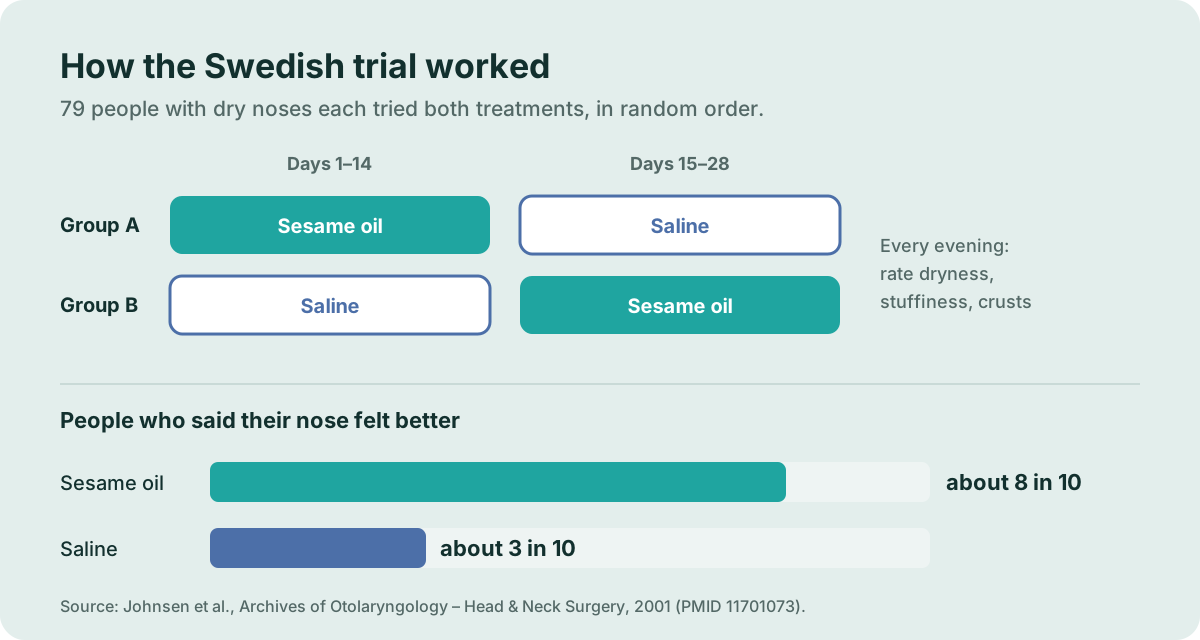
- 79 adults with dry noses each tried pure sesame oil for 14 days and saline for 14 days, in random order.
- Dryness, stuffiness and crusting all improved significantly more with sesame oil.
- About 8 in 10 people reported improvement with the oil versus 3 in 10 with saline. Side effects were few and short-lived.
- It was one study, in one season, in one Swedish town. It supports oil-based moisturizers for dryness but does not test any brand-name product.
Most advice for a dry nose starts with saline spray. It is cheap, gentle and easy to find. But a small, well-designed trial from Sweden is one of the reasons doctors also recommend oil-based nasal moisturizers.
The question
Researchers at the County Hospital in Skellefteå, in northern Sweden, wanted to know whether pure sesame oil worked any better than isotonic saline (salt water at the same concentration as body fluids) for people whose nasal lining was dry.
Skellefteå made a good test site. During the study, from mid-March to the end of May 2000, the outdoor absolute humidity was low, so participants were dealing with real seasonal dryness.

How the study worked
The team enrolled 79 people with nasal mucosa dryness and used a crossover design:
- Half the group used sesame oil for 14 days, then switched to saline for 14 days.
- The other half did the same in reverse.
Because everyone tried both, each person acted as their own comparison. That cuts out a lot of the noise that comes from comparing different people.
Every evening, participants rated three symptoms on a visual scale: dryness, stuffiness and crusting.
What they found
| Measure | Sesame oil | Saline |
|---|---|---|
| Dryness | Improved significantly more | Smaller improvement |
| Stuffiness | Improved significantly more | Smaller improvement |
| Crusting | Improved significantly more | Smaller improvement |
| People reporting their nose felt better | About 8 in 10 | About 3 in 10 |
All three differences were statistically strong. Adverse events were described as few and temporary.
The authors concluded that for nasal dryness caused by a dry winter climate, pure sesame oil was significantly more effective than saline.
Why oil might make the difference
Saline wets the surface, but water evaporates, especially in dry air. An oil spreads into a thin film that slows evaporation from the lining underneath. That is the same reason lip balm works better than licking your lips.
What this study can't tell you
- It was small and local. 79 people in one town over one spring. Results in other climates and age groups could differ.
- Symptoms were self-rated. Participants knew which product they were using, since oil and saline feel very different. That can nudge ratings.
- It tested one ingredient. The study used pure sesame oil. It says nothing directly about blends or specific brands.
- It was about dryness. It did not test nosebleeds, infections or chronic sinus disease.
What it means in practice
If saline alone has not been enough for a dry, crusty nose in winter, this trial gives reasonable support for trying an oil-based nasal moisturizer made for use in the nose. It pairs well with a bedroom humidifier. Seasonal research also shows nosebleed visits peak in winter as humidity drops, so keeping the lining moist is worth the small effort.
Anyone with a sesame allergy should avoid sesame-based products, and persistent or one-sided symptoms deserve a doctor's look.
Common questions
Is sesame oil better than saline spray for a dry nose?
In this trial it relieved dryness, stuffiness and crusting more than isotonic saline. Saline still has a role for rinsing out mucus and allergens. Many people use both.
Why would oil work better than saline?
Saline adds water that evaporates fairly quickly. Oil forms a thin film over the lining that slows moisture loss, so the effect lasts longer between doses.
Is it safe to put sesame oil in your nose?
The trial reported few, temporary side effects. Use products made for nasal use rather than cooking oil, skip it if you have a sesame allergy, and ask a doctor before using any oil in a young child's nose.
Sources
- Pure sesame oil vs isotonic sodium chloride solution as treatment for dry nasal mucosa. Archives of Otolaryngology – Head & Neck Surgery, 2001
- Examining seasonal variation in epistaxis in a maritime climate. Journal of Otolaryngology – Head & Neck Surgery, 2019
Articles are for general information, not medical advice. See a doctor for symptoms that are severe, persistent, or one-sided. Last updated October 24, 2026.