Rhinitis Sicca: What a Chronically Dry Nose Means
Rhinitis sicca is a long-lasting dry nose, from mild dryness to crusting. Learn the causes, how it differs from atrophic rhinitis, and when to see a doctor.

The short version
- Rhinitis sicca means a dry nose that lasts, ranging from a dry feeling alone to visible crusts inside the nostrils.
- A 2011 review found there is no single agreed definition of dry nose, so doctors rely on history, a nose exam and sometimes endoscopy.
- Past turbinate surgery is described in the medical literature as a significant and frequent factor in long-term dry nose.
- Dryness with foul smell, heavy crusting, repeated bleeding or loss of smell needs a doctor's visit, not just home care.
Rhinitis sicca is the medical term for a dry nose that does not go away. Many people have it, yet it is often brushed off as a winter nuisance. This guide explains what it is, what causes it, what helps, and when it needs a doctor.
What is rhinitis sicca?
Rhinitis sicca means a chronically dry nose. "Rhinitis" means irritation of the nose lining, and "sicca" is Latin for dry. The most common form is rhinitis sicca anterior, which affects the front part of the nose.
A 2011 literature review in the European Archives of Oto-Rhino-Laryngology (Hildenbrand and colleagues) points out a problem: despite how many people suffer from dry nose, there is no unequivocal definition. Symptoms range from a purely subjective feeling of dryness to visible crusting on the inner nose lining, with many combinations in between. So two people can both say "my nose is dry" and have very different things going on.
What does a chronically dry nose feel like?
It often feels tight, scratchy or crusty, and it may bleed a little when crusts come off. Common signs include:
- A dry or "tight" feeling inside the nostrils
- Crusts or scabs that keep coming back
- Small, repeated nosebleeds, often when blowing or picking
- A sore or cracked area at the front of the nose
- A feeling that air moves oddly or the nose is blocked even when it is not
The review notes that the feeling alone, with no visible damage, still counts as part of the dry nose picture. Your symptoms matter even if a doctor sees a normal-looking nose.
How is rhinitis sicca different from atrophic rhinitis?
Rhinitis sicca anterior is the milder end of the spectrum. Atrophic rhinitis is a more serious condition where the nose lining thins and shrinks over time. The review groups these conditions together under the symptom "dry nose."
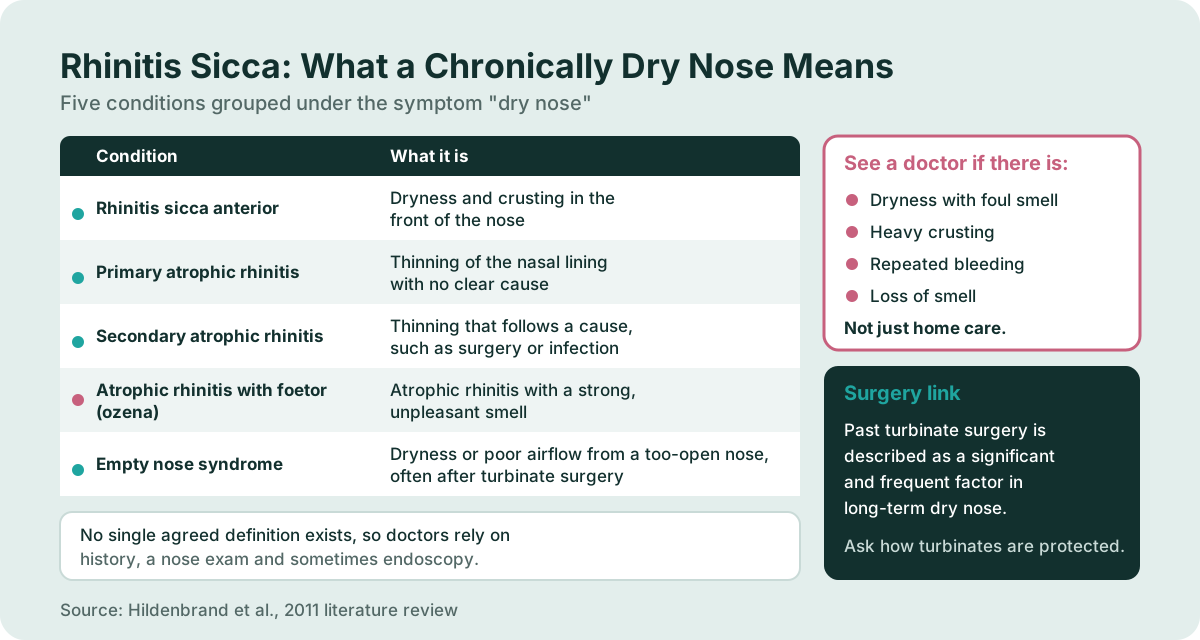
| Condition | Short description |
|---|---|
| Rhinitis sicca anterior | Dryness and crusting in the front of the nose |
| Primary atrophic rhinitis | Thinning of the nasal lining with no clear cause |
| Secondary atrophic rhinitis | Thinning that follows a cause, such as surgery or infection |
| Atrophic rhinitis with foetor (ozena) | Atrophic rhinitis with a strong, unpleasant smell |
| Empty nose syndrome | A feeling of dryness or poor airflow when the nasal space is too open, often after turbinate surgery |
Telling these apart takes an exam. That is one reason a dry nose that lasts for weeks deserves a professional look.
What causes a chronically dry nose?
There is rarely one cause. Often several small ones stack up. Well-known contributors include:
- Dry indoor air. Heating in winter and air conditioning in summer pull moisture from the nose lining.
- Mouth breathing. Air that skips the nose's humidifying job dries out whatever it does touch.
- Overuse of decongestant sprays. Using them for more than about three days in a row can make the nose more irritated and congested.
- Nose picking and rough blowing. These damage the delicate front lining.
- Some medicines and conditions. Certain allergy pills, and autoimmune conditions that dry out the body's moist surfaces, can contribute.
- Smoke, dust and fumes. The review lists "injurious factors" to avoid as part of care.
- Nasal surgery. This one is especially important, as the next section explains.
Can nose surgery cause a dry nose?
Yes. The 2011 review says that uncritical removal of the nasal turbinates is a significant and frequent factor in the development of dry nose, secondary atrophic rhinitis and empty nose syndrome. Turbinates are the ridges inside the nose that warm and moisten the air you breathe.
Based on this, the authors argue that the inferior and middle turbinate should not be removed without adequate justification. They also say both should not be removed at the same time except for a malignant (cancer) condition. If you are considering nasal surgery, ask your surgeon how they plan to protect the turbinates and the moisture-making lining.
How do doctors diagnose it?
Diagnosis rests mainly on your history and a look inside the nose. According to the review, doctors use:
- Your history: when the dryness started, past surgery, medicines, work and home air.
- Inspection of the outer and inner nose.
- Endoscopy, which uses a thin camera to see the nasal cavity, sinuses and the back of the nose.
- When needed, a CT scan, allergy testing or microbiological swabs.
Most people with simple dryness will not need all of these. The extra tests are for cases that look more complicated.
What helps a chronically dry nose?
The review describes management as removing the causes, adding moisture, and caring for the lining. In practical terms, that looks like this:
- Fix the air. Aim for indoor humidity of roughly 30 to 50 percent. Higher can encourage mold and dust mites.
- Add moisture to the nose. Saline sprays or gels, and gentle nasal moisturizers, keep the lining from drying out between doses. Oil-based options such as Narisure, a nasal moisturizer that soothes and moisturizes dry nasal passages, are one choice some people use at the front of the nostril.
- Do not pick or scrub crusts. Softening them with moisture first is gentler than pulling them off.
- Cut irritants. Smoke, strong fumes and dusty spaces dry and inflame the lining.
- Stop long use of decongestant sprays after a few days, and ask a pharmacist or doctor for alternatives.
- Drink enough water. It will not fix severe dryness alone, but dehydration does not help.
If an infection is present, it needs its own care from a doctor. The review lists treatment of infections as part of the plan.
Is there any research on newer moisturizing ingredients?
A little, but it is early. A 2019 systematic review in BioMed Research International looked at ectoine, a molecule used in some nasal sprays, and its effects on upper airway inflammation. The authors found only six relevant publications. Of these, one was about rhinitis sicca anterior, two were about allergic rhinitis, one about acute rhinosinusitis, and two about throat inflammation.
The authors suggested that, because of its moisturizing and anti-inflammatory properties, topical ectoine could play an additional role in sinonasal conditions. They also warned that the results should be viewed with caution. The number of studies was small, and some were probably underpowered because of small patient groups. In plain terms, this is a promising lead, not a settled answer for dry nose.
When should you see a doctor?
See a doctor if dryness lasts more than a few weeks despite home care, or if you notice any of these:
- Heavy or thick crusts that keep returning
- A foul smell from the nose
- Nosebleeds that are frequent, heavy or last more than 20 minutes with pressure
- Loss or change in sense of smell
- Pain, swelling or sores that do not heal
- Dryness that began after nasal surgery
- Blockage on only one side that does not clear
Get urgent care for a nosebleed that will not stop after 20 minutes of firm pressure, or one that follows a head injury. A doctor can tell simple dryness from atrophic changes and check for infection or other causes. If you live in the Garden State, you can find nose and sinus doctors in New Jersey who evaluate chronic dryness and crusting.
Common questions
What is rhinitis sicca?
Rhinitis sicca is a long-lasting dry nose. Symptoms range from a dry, tight feeling to visible crusting on the nose lining. The most common type, rhinitis sicca anterior, affects the front of the nose. A 2011 review noted there is no single agreed definition, so diagnosis depends on history and an exam.
Is a chronically dry nose the same as atrophic rhinitis?
No. A dry nose or rhinitis sicca anterior is usually the milder form, with dryness and crusting at the front. Atrophic rhinitis involves thinning of the nasal lining and can bring heavy crusts or a foul smell. Both fall under the symptom of dry nose, so an exam helps tell them apart.
Can nasal surgery make your nose dry for good?
It can contribute. A 2011 review states that removing nasal turbinates without strong reasons is a significant and frequent factor in dry nose, secondary atrophic rhinitis and empty nose syndrome. Not everyone is affected, but the authors advise against resecting the inferior and middle turbinates without adequate justification.
When is a dry nose a sign of something serious?
See a doctor if dryness lasts several weeks despite home care, or comes with heavy crusts, a foul smell, repeated or heavy nosebleeds, sores that do not heal, or loss of smell. One-sided blockage that does not clear also needs checking. These signs can point to something beyond simple dryness.
Sources
- Topical Ectoine: A Promising Molecule in the Upper Airways Inflammation-A Systematic Review. BioMed research international, 2019
- Rhinitis sicca, dry nose and atrophic rhinitis: a review of the literature. European archives of oto-rhino-laryngology, 2011
Trusted resources
From our sister sites
NJ Sinus & AllergyRagweed Season in New Jersey: Peak Dates and How to CopeRagweed season in New Jersey usually starts in mid-August and peaks in September. Learn what helps, food reactions, testing, and when to see a doctor.Coastal SinusHow Long Does a Sinus Infection Last? When to WorryMost sinus infections clear up on their own in 7 to 10 days. Get the full timeline, warning signs of a bacterial infection, and when to call a doctor.Articles are for general information, not medical advice. See a doctor for symptoms that are severe, persistent, or one-sided. Last updated November 5, 2026.