Decongestant Spray Rebound Congestion: How Long Is Too Long?
Rebound congestion from nasal decongestant sprays is tied to overuse. See how long is safe, the warning signs, and how to stop, based on the research.

The short version
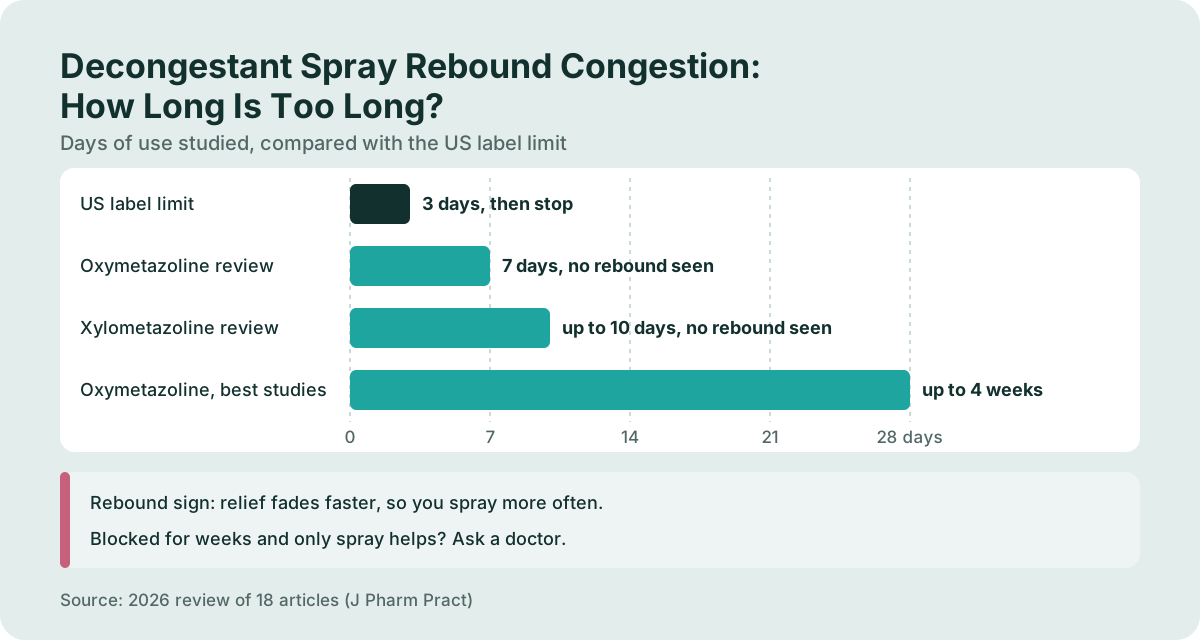
- A 2026 review of 18 articles found no evidence of rebound congestion after 7 days of oxymetazoline or up to 10 days of xylometazoline.
- Rebound congestion (rhinitis medicamentosa) is linked to prolonged or excessive use, and the usual pattern is relief that wears off faster, so people spray more often.
- US labels for oxymetazoline typically say to stop after 3 days, so following the label is the safe default.
- If a nose has stayed blocked for weeks and the spray is the only thing that helps, a doctor can find the underlying cause and plan a safe way to stop.
Decongestant nasal sprays work fast. Many people then use them for weeks, and the nose starts to feel more blocked than before. That pattern is called rebound congestion, and the research says it is mostly a problem of using the spray too long or too often.
What is rebound congestion from nasal spray?
Rebound congestion is a blocked nose that comes back, or gets worse, as a decongestant spray wears off. When it becomes long-lasting, doctors call it rhinitis medicamentosa (RM).
Decongestant sprays such as oxymetazoline and xylometazoline narrow the blood vessels in the lining of the nose. That shrinks swelling and opens the airway. A 2025 review in Frontiers in Pharmacology (Stinson and Sadofsky) describes RM as chronic congestion from prolonged or excessive use. The nose responds less to the spray, and the relief lasts for shorter periods. People then spray more often or use more, which makes the congestion worse. The review says it is unclear exactly why this happens.
How long can you safely use a decongestant nasal spray?
Follow the label. On US products, oxymetazoline labels typically say to use it no more than twice in 24 hours and to stop after 3 days.
The research suggests the true risk threshold may sit somewhat beyond that, but the evidence has limits. A 2026 review in the Journal of Pharmacy Practice looked at 18 articles. Thirteen studied oxymetazoline and five studied xylometazoline. It found:
- No evidence of rebound congestion after 7 days of oxymetazoline (up to 400 micrograms a day).
- No evidence of rebound congestion after up to 10 days of xylometazoline (840 micrograms a day).
- No rebound, or tolerance, in well-designed studies of up to 4 weeks of oxymetazoline.
- No studies at all on naphazoline, phenylephrine or ephedrine.
There are two things to keep in mind. This was a literature review, not a new trial. And the authors are affiliated with a consumer health company, so the paper leans toward reassurance about short-term use. Its own conclusion is that the findings apply to short-term use at the recommended dose and frequency. It also notes that some people go past the label limit.
The practical rule is simple. Short, labeled use looks low-risk. Longer use is where the problems are reported.
What are the signs of rebound congestion?
The main sign is a nose that feels blocked again soon after each dose, so you need the spray more often to breathe.
| Pattern | Normal short-term use | Possible rebound |
|---|---|---|
| Length of use | A few days | Weeks or months |
| How long relief lasts | Hours | Gets shorter over time |
| How often you spray | As labeled | More often than labeled |
| Without the spray | Congestion fades as the cold or allergy fades | Nose feels more blocked than before |
| Sleep | Usually better | Waking up blocked, reaching for the bottle |
A hard part is that the original problem may still be there. The Stinson and Sadofsky review points out that it is difficult to tell where the underlying disease (such as allergies) ends and RM begins. A nose that stays blocked after stopping may not be rebound at all.
Does the spray itself cause rebound, or the preservatives?
Nobody knows for sure. The 2025 review says it is still to be determined whether rebound comes only from the decongestant drug or also from preservatives in the spray.
That review suggests the mechanisms could include changes in the nose lining, in how sensitive receptors are, or in the nerves. It also says that better education, preservative-free formulas and the lowest effective dose may help prevent RM. Note that this paper was funded by a large consumer health company, which was involved in its design and editing.
Can decongestant spray overuse harm anything besides the nose?
There is no good human evidence of this. One animal study used 30 rats to model rhinitis medicamentosa with oxymetazoline. It found changes in lung cell-death pathway markers. The authors suggested that blood vessel narrowing might reduce blood supply and trigger these cell responses.
This was a rat study looking at lab markers. It does not show that sprays harm human lungs. It is a reason for more research, and not a reason for alarm.
How do you stop using a decongestant spray?
Stop using it, and expect a few uncomfortable days. Some people can quit all at once. Others find it easier to stop one nostril first and then the other.
These general steps are commonly recommended:
- Pick a stop date. Tell yourself the first few nights may be stuffy.
- Try one nostril at a time. Keep using the spray in one side while the other side recovers, then stop the second side.
- Use plain saline. Saline spray or a rinse can loosen mucus and keep the nose lining moist. Our guide to nasal saline rinses covers safe technique.
- Sleep with your head raised. An extra pillow can help drainage.
- Ask about a steroid spray. A doctor may prescribe a steroid nasal spray to calm swelling during the switch.
Steroid sprays have some support here. A 2022 systematic review in the Journal of Laryngology and Otology pooled 4 randomized trials with 838 people who had chronic rhinitis. It found that a steroid spray plus oxymetazoline improved congestion more than either alone, and the combination did not cause rhinitis medicamentosa. Nasal volume was 15.8 ml with the combination, against 12.1 ml for placebo and 12.4 ml for oxymetazoline alone. There were only four trials, and the people studied had chronic rhinitis, so this is not a plan for self-treating at home. It does show why a doctor may combine approaches.
What helps a dry or irritated nose after stopping?
A gentle moisturizer may help the nose feel more comfortable. Some people notice dryness or crustiness while the lining settles down. Saline mist is a common first choice. An oil-based option such as Narisure, a nasal moisturizer that soothes and moisturizes dry nasal passages, is another. These are for comfort and do not relieve congestion.
What if allergies or a cold are the real problem?
Treating the cause is the way out. If you reached for the spray because of allergies, see sinus pressure from allergies: causes and what helps for the usual approaches. Colds usually clear on their own within about 7 to 10 days, which is within the window where short use looks low-risk.
When should you see a doctor?
See a doctor if you have used a decongestant spray for more than a week and your nose is still blocked, or if you cannot sleep or function without it.
Also get checked for any of these:
- Congestion lasting more than 10 days, or symptoms that improve and then get worse.
- Facial pain or swelling, a high fever, or thick colored discharge with severe pressure.
- Repeated nosebleeds, or blood-streaked mucus, after using sprays.
- One side that is always blocked, which can point to a structural issue like a deviated septum.
- Use of any nasal spray in a child under 6 without a clinician's advice.
- High blood pressure, heart disease or glaucoma. Decongestants can matter for these conditions, so check with a pharmacist or doctor first.
If your congestion needs a closer look, you can find nose and sinus doctors in New Jersey who can sort out whether rebound, allergies or something structural is behind it.
Common questions
How long does rebound congestion last after stopping nasal spray?
It varies. Many people feel worse for several days after stopping, and some take a couple of weeks to settle. The studies provided do not give a firm timeline, so treat this as general experience. If your nose is still blocked after two weeks, see a doctor to look for another cause.
Is it safe to use Afrin or oxymetazoline for 5 days?
The label usually says to stop after 3 days. A 2026 review found no evidence of rebound after 7 days of oxymetazoline at normal doses, but that does not change the label. Using it a little longer is unlikely to be the main concern. Using it beyond a week, or more often than directed, is where problems are reported.
Can you become addicted to nasal decongestant spray?
Doctors describe it as dependency rather than classic addiction. A 2025 review says that when relief shortens, people spray more often, which worsens congestion and creates reliance on the spray. This is linked to prolonged or excessive use. Stopping the spray with a doctor's or pharmacist's guidance is the usual way out.
Do saline sprays cause rebound congestion?
No. Plain saline does not narrow blood vessels, so the rebound pattern described in the research applies to decongestant drugs such as oxymetazoline and xylometazoline. Saline is often used to keep the nose lining moist and loosen mucus, including while someone is stopping a decongestant spray.
Sources
- Revisiting Rhinitis Medicamentosa: Examining the Evidence on Topical Nasal Decongestants. Journal of pharmacy practice, 2026
- Intranasal corticosteroid and oxymetazoline for chronic rhinitis: a systematic review. The Journal of laryngology and otology, 2022
- Part 1 - imidazolines and the changing face of nasal decongestants. Frontiers in pharmacology, 2025
- Part II - imidazolines and rhinitis medicamentosa: how can we tackle the rebound dilemma?. Frontiers in pharmacology, 2025
- Investigation of Cytotoxic Effects of Oxymetazoline on Lungs in a Rat Model of Rhinitis Medicamentosa. Current molecular pharmacology, 2021
Trusted resources
From our sister sites
Coastal SinusHow Long Does a Sinus Infection Last? When to WorryMost sinus infections clear up on their own in 7 to 10 days. Get the full timeline, warning signs of a bacterial infection, and when to call a doctor.NJ Sinus & AllergySinus Pressure From Allergies: Causes and What HelpsAllergies swell the nasal lining and block sinus drainage, which causes pressure. Learn why it happens, what helps, and when to see a doctor in NJ.Articles are for general information, not medical advice. See a doctor for symptoms that are severe, persistent, or one-sided. Last updated November 9, 2026.