Dry Nose From Oxygen Tubing in Older Adults: What Helps
Oxygen tubing can dry the nose, more so at higher flows. See what studies say about humidifiers, what helps at home, and when to call a doctor.

The short version
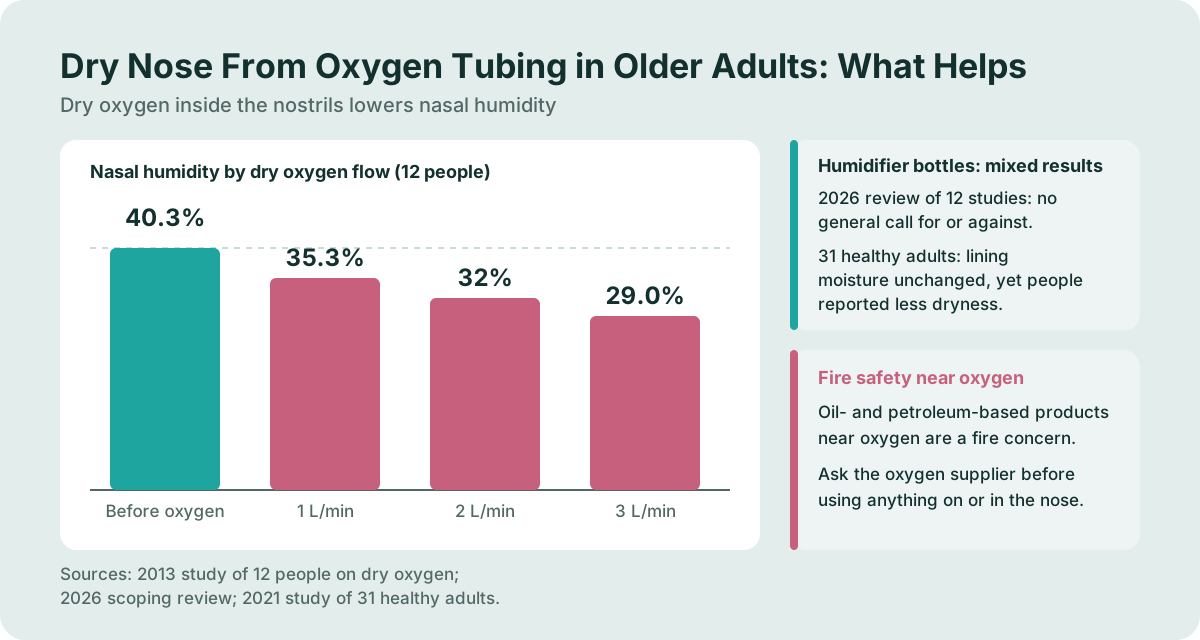
- In a 12-person study, dry oxygen delivered inside the nostrils lowered nasal humidity from 40.3% to 29.0% at 3 liters per minute.
- A 2026 scoping review of 12 studies found mixed results on routine humidifiers and made no general recommendation for or against them.
- In a 31-person study of healthy adults, cold bubble humidification did not change nasal lining moisture, but people reported less dryness.
- Oil-based and petroleum-based products near oxygen are a fire concern, so ask the oxygen supplier before using anything on or in the nose.
Oxygen tubing sits right at the nostrils, and many people who use it notice a dry, crusty or sore nose. This is common, and it matters more for older adults who may use oxygen for many hours a day. The research on fixes is small and mixed, but a few practical points are clear.
Why does oxygen through a nasal tube dry out the nose?
Oxygen from tanks and concentrators is dry gas. When it flows past the nasal lining, it can pull moisture from the surface, and the higher the flow, the bigger the effect.
A 2013 German study measured this directly. Researchers sampled air from inside the noses of 12 people using oxygen. When dry oxygen was given through a cannula sitting inside the nostrils (an intranasal cannula), nasal humidity fell as the flow went up:
| Oxygen flow (dry, intranasal cannula) | Nasal humidity |
|---|---|
| Before oxygen (starting level) | 40.3% |
| 1 liter per minute | 35.3% |
| 2 liters per minute | 32% |
| 3 liters per minute | 29.0% |
When oxygen was given pre-nasally, meaning in front of the nostrils instead of inside them, there was no significant change in nasal humidity. The study was small, and the people were measured over a short time. It shows that tube design and flow rate both play a role.
Does a bubble humidifier fix a dry nose from oxygen?
Not reliably. Studies disagree about whether routine bubble humidifiers help, and no general rule has been set.
Here is what the research shows:
- Scoping review (2026). This review mapped 12 studies of adults on low-flow oxygen through a nasal cannula or mask. Results on comfort were inconsistent. Some contamination findings appeared for reusable devices, but there was little evidence of harm to patients. The authors said the evidence does not support a general recommendation for routine humidification. They favored case-by-case decisions that are rechecked over time.
- Healthy volunteers (2021). In 31 healthy adults given 3 liters per minute for one hour, cold bubble humidification did not change nasal inflammation, mucus clearance or the moisture of the nasal lining. Even so, people in the humidified groups reported less nasal dryness. Humidifying may make the nose feel better without changing the lining itself. The study was small, short and did not include people on long-term oxygen.
- Pre-nasal oxygen (2013). Dry oxygen given in front of the nostrils kept nasal humidity at levels similar to intranasal oxygen with a bubble humidifier. In that study, a different cannula style did about the same job as adding water.
- Hospital practice (2026). A children's hospital stopped using bubble humidifiers on low-flow oxygen in May 2024, following a respiratory care guideline. In a later survey of 132 staff, 45% were indifferent to the change and 35% disagreed. Most worried about patients, and nasal irritation or dryness topped the list, followed by nosebleeds. This was a survey of opinions in a children's hospital, not a test of patient outcomes, so it cannot show who is right.
Bottom line: a humidifier bottle may help how the nose feels, but it is not proven to protect the nasal lining. Whether to use one is a decision for the person's care team.
Is high-flow oxygen different?
High-flow nasal cannula therapy delivers warmed, humidified gas at much higher flow rates, usually in hospitals. Because the gas is already humidified, the question there is about comfort and temperature.
An Italian trial randomized 21 intensive care patients, aged 34 to 85, to three temperature plans. One group stepped up from 31 to 34 to 37°C. One stepped up from 34 to 37°C. One stayed at 37°C. After 30 minutes, comfort scores (rated 1 to 5) averaged 3.3, 2.7 and 3.1 respectively, with no significant difference (p = .714). Nasal dryness and humidity ratings also did not differ across groups, though the dryness p-value of .05 sat right at the line. With only 21 patients, the study cannot rule out real differences.
What can help a dry nose while using oxygen at home?
Simple, gentle steps are the safest place to start. Check each one with the oxygen supplier or care team first.
- Ask about the cannula type. Pre-nasal cannulas sit in front of the nostrils, and one study found they kept nasal humidity steadier. Only a clinician can say if that suits the prescription.
- Use a saline nasal spray or a water-based gel. These are generally the products suppliers recommend. Check the label for "water-based."
- Avoid petroleum jelly and oil-based products on or in the nose while oxygen is in use. Oxygen makes fires burn faster and hotter, and oil-based products can add fuel. Ask the supplier before using any oil, balm or ointment near the tubing.
- Drink fluids through the day, unless a doctor has limited fluids for heart or kidney reasons.
- Add moisture to the room. A clean cool-mist humidifier in the bedroom can ease dryness overnight. Wipe it down often so it does not grow mold.
- Keep equipment clean. Replace cannulas on the supplier's schedule. If a bubble humidifier is used, empty, wash and refill it as the instructions say. The scoping review found contamination concerns mainly with reusable devices.
- Check for rubbing. Tubing that tugs at the nostril can make the skin sore. Ask the supplier about softer tubing or a different fit.
- Review other medicines. Some allergy pills dry the nose too, as explained in antihistamines and a dry nose. Ask a doctor or pharmacist before changing any medicine.
Never change the oxygen flow rate to ease dryness. The prescribed amount matters for safety.
What if the nose bleeds with oxygen tubing?
A dry nasal lining cracks easily, so small nosebleeds are a common complaint with oxygen use. Most are minor and stop within minutes.
- Sit up and lean slightly forward.
- Pinch the soft part of the nose, just below the bony bridge, for a full 10 minutes without checking.
- Breathe through the mouth.
- Do not tilt the head back.
People who rely on oxygen should ask their care team ahead of time how to handle a bleed, including whether the oxygen can be paused or moved. Do not stop oxygen on your own without that advice. Anyone taking blood thinners should tell their doctor about repeated bleeds.
When should you see a doctor about a dry nose from oxygen?
Call the care team if any of these happen:
- Nosebleeds happen more than once a week or last longer than 20 minutes.
- Heavy bleeding occurs, especially with blood thinners.
- The nose has painful sores, scabs that will not heal or visible cracks.
- There is a foul smell, thick yellow-green discharge or facial pain.
- Dryness is so bothersome that oxygen use is being skipped.
Go to emergency care for bleeding that will not stop after 20 minutes of steady pressure, bleeding after a fall or head injury, or trouble breathing. For help finding a specialist who can check the nasal lining and review the oxygen setup, see nose and sinus doctors in New Jersey.
Common questions
Why does my nose get so dry when I use an oxygen concentrator?
Oxygen from a concentrator or tank is dry gas, and it can pull moisture from the nasal lining. In a 12-person study, dry oxygen at 3 liters per minute through an intranasal cannula dropped nasal humidity from 40.3% to 29.0%. Higher flows tend to dry more.
Do I need a humidifier bottle with a nasal cannula?
Not always. A 2026 scoping review of 12 studies found mixed results and made no general recommendation for routine humidifiers. One study found they eased dryness symptoms without changing the nasal lining. Ask the oxygen supplier or doctor what fits the prescribed flow.
Can I put Vaseline in my nose while on oxygen?
Petroleum jelly and other oil-based products are generally advised against with oxygen because of fire risk. Water-based gels and saline sprays are the usual choices. Check with the oxygen supplier or doctor before putting anything on or in the nose while oxygen is in use.
Is a nosebleed from oxygen tubing dangerous?
Most are minor and stop with 10 minutes of steady pressure on the soft part of the nose. Seek urgent care if bleeding lasts over 20 minutes, is heavy, or happens with blood thinners. Repeated bleeds should be reviewed by a doctor.
Sources
- The starting temperature of high-flow nasal cannula and perceived comfort in critically ill patients: A pragmatic randomized controlled trial. Nursing in critical care, 2024
- Humidification in low-flow oxygen therapy in adults: comfort, safety and nursing practice. Enfermeria intensiva, 2026
- Cold bubble humidification of low-flow oxygen does not prevent acute changes in inflammation and oxidative stress at nasal mucosa. Scientific reports, 2021
- Attitudes Regarding De-Implementation of Bubble Humidification for Low-Flow Oxygen Delivery in a Children's Hospital. Respiratory care, 2026
- Humidification of inspired oxygen is increased with pre-nasal cannula, compared to intranasal cannula. Respiratory care, 2013
Trusted resources
From our sister sites
NJ Sinus & AllergyAntihistamines and a Dry Nose: Why Allergy Pills Dry You OutAntihistamines can dry a runny nose, and older ones do it more. Learn why allergy pills leave you dry, what the studies show, and how to ease it.Coastal SinusSummer Humidity, Mold and Sinus Flare-Ups at the ShoreHumid shore summers can feed indoor mold that irritates the nose and sinuses. Learn the signs, what studies show, and how to cut damp at home.Articles are for general information, not medical advice. See a doctor for symptoms that are severe, persistent, or one-sided. Last updated November 13, 2026.