Nasal Saline Rinses: How to Do Them Safely at Home
Safe saline rinse basics: use distilled, sterile or boiled-and-cooled water, clean the device, and know when to stop. A plain-language guide with study notes.

The short version
- The water matters most: use distilled, sterile, or tap water that was boiled and cooled. Plain tap water can carry germs that are harmful in the nose.
- Use a salt level close to body fluids (0.9%, called isotonic), ideally from a premixed packet, so the rinse does not sting.
- Wash the device after every use and let it air-dry. Replace it on the maker's schedule.
- Research on saline rinses is mixed: a 2012 review found them ineffective for adult cold symptoms, and a 2025 review lists them as an add-on that may ease symptoms of sinus infections in children.
A saline rinse flushes the inside of the nose with salty water. Done right, it is simple and low-risk. Done wrong, with the wrong water or a dirty bottle, it can cause real harm.
This guide covers the water, the salt, the steps, how often to rinse, and when to stop and call a doctor.
What kind of water is safe for a nasal rinse?
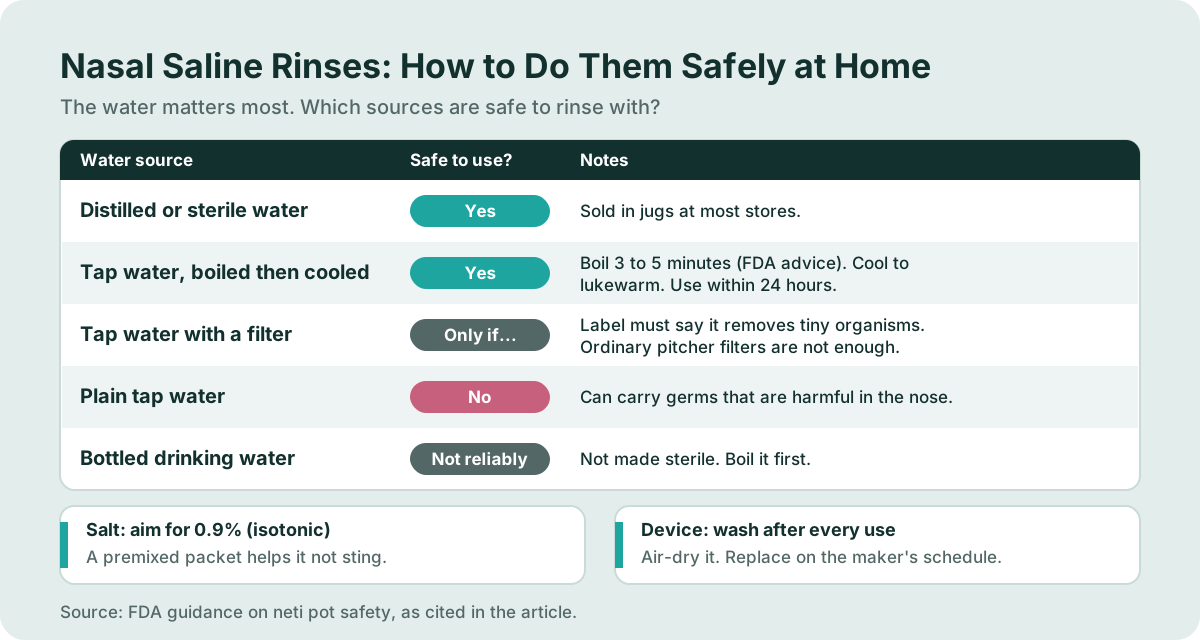
Use distilled water, sterile water, or tap water that has been boiled and cooled. Do not use plain water straight from the tap.
Tap water is safe to drink, but stomach acid kills the germs in it. In the nose, nothing does that. The FDA warns about this in its guidance on neti pot safety. Rare but serious infections have happened after people rinsed with untreated tap water.
| Water source | Safe for rinsing? | Notes |
|---|---|---|
| Distilled or sterile water | Yes | Sold in jugs at most stores. |
| Tap water, boiled then cooled | Yes | The FDA advises boiling for 3 to 5 minutes. Cool to lukewarm. Use within 24 hours. |
| Tap water with a filter | Only if the filter is rated to remove tiny organisms, and the label says so | Ordinary pitcher filters are not enough. |
| Plain tap water | No | Can carry germs that are harmful in the nose. |
| Bottled drinking water | Not reliably | Not made sterile. Boil it first. |
How much salt should be in a saline rinse?
Aim for an isotonic solution, about 0.9% salt. That matches the saltiness of your body's fluids, so it feels gentle instead of burning.
The easiest way is a premixed packet made for nasal rinses. Follow the directions on the box for how much water to add. If you mix your own, use non-iodized salt with no additives, and measure carefully. Too much salt stings and dries the nose. Too little can also irritate it.
How do you do a saline rinse step by step?
Lean over a sink, tilt your head, pour or squeeze the solution into the upper nostril, and let it drain out of the lower one. Then repeat on the other side.
- Wash your hands.
- Mix the rinse with safe water. Make it lukewarm, not hot.
- Lean over the sink and tilt your head sideways. Keep your forehead level with your chin.
- Breathe through your open mouth. This keeps the water out of your throat.
- Gently pour or squeeze the solution into the upper nostril. It should flow out of the other nostril.
- Switch sides. Use about half the bottle or pot per side.
- Blow your nose gently afterward. Do not pinch one side hard, because that can push fluid toward the ear.
If it stings, the salt level or the temperature is probably off. If water goes down your throat, tilt your head a bit more and keep breathing through your mouth.
How do you clean a neti pot or squeeze bottle?
Wash it with soap and warm water after every use, rinse with safe water, and let it air-dry completely. Do not leave it wet in a closed cabinet.
A damp bottle grows germs. Dry it upside down on a clean paper towel, or use a clean cloth. Many makers say to replace squeeze bottles every few months, so check the label. Never share a device with anyone else, even family.
How often should you rinse your nose?
For most people, once or twice a day during a stuffy spell is typical. Rinsing more than that does not help more, and some people find that daily rinsing dries the nose out.
If your nose feels tight, crusty or sore after rinsing, cut back. Try every other day or only when you feel congested. Rinsing washes away mucus, which is the nose's natural coating. Too much rinsing can leave the lining drier than before.
Do saline rinses actually work for colds and sinus infections?
The evidence is mixed, and it depends on age and the illness.
A 2012 review in American Family Physician looked at treatments for the common cold. It listed nasal saline irrigation among the treatments that were ineffective at relieving cold symptoms in adults. For children, the same review said nasal saline irrigation reduced the number of colds. The limit here is that this was a summary of earlier research, not a new trial, and it is now more than a decade old.
A 2025 review of acute sinus infections in children (Paediatric Respiratory Reviews) described nasal saline irrigation as an add-on therapy that may give symptom relief, alongside pain relievers and sometimes steroids. It did not present rinses as a replacement for medical care. The review also noted that most of these infections follow a virus and clear on their own, while bacterial ones can sometimes cause serious complications.
A 2020 systematic review and meta-analysis (Paediatric Respiratory Reviews) looked at randomized trials of isotonic saline irrigation in babies aged 3 months and older and children up to 12 with sudden upper airway infections. Its design was to compare saline with no treatment or a less-intensive therapy. The summary available here does not include its numbers, so treat it as a sign that researchers are actively testing this question, not as proof either way.
For long-lasting sinus problems, you can read more in saline irrigation for chronic sinusitis: what the trials found.
Should you add medicine to a saline rinse?
Only if a doctor prescribes it. A 2025 meta-analysis in Rhinology pooled 26 studies with 1,464 people who had chronic rhinosinusitis. Rinses mixed with the steroid budesonide scored better than plain saline rinses on a symptom questionnaire (SNOT-22) and on a doctor's endoscopy score. Eye pressure and cortisol levels stayed in a normal range.
That result is for prescribed treatment under medical supervision, in people with long-term sinus disease. It does not mean anyone should mix drugs into a home rinse. Do not add anything to your rinse, including essential oils, hydrogen peroxide or other additives, unless a doctor tells you to.
Are saline rinses safe for kids?
For young children, gentle saline drops or spray are usually used instead of a full rinse. Ask a pediatrician which method fits your child's age.
The same safe-water rules apply, and an adult should always do it. Do not force fluid into a child's nose. Stop if the child is upset or choking.
When should you skip a rinse or stop?
Skip the rinse and wait if your nose is completely blocked on both sides. Fluid has nowhere to drain. Stop and rest the nose if you get nosebleeds, sharp pain or lasting irritation.
Other common side effects include a burning feeling, a salty taste in the throat, and sometimes a feeling of water in the ear. These usually mean the water was too salty, too cold or too hot, or the head was tilted wrong.
When to see a doctor
A rinse can ease congestion, but it cannot tell you what is causing it. See a doctor if:
- Sinus symptoms last more than 10 days without getting better, or get worse after seeming to improve.
- You have a fever above 102°F (38.9°C), or severe facial pain.
- There is swelling or redness around the eyes, vision changes, or a very stiff neck or bad headache. Get urgent care right away for these.
- Your nose bleeds often during or after rinsing.
- Thick, one-sided or bloody discharge keeps coming back.
- A child under 3 months has nasal symptoms, or any child seems very sick.
For general background on sinus infections, see MedlinePlus on sinusitis. If rinsing does not help or keeps causing problems, nose and sinus doctors in New Jersey can check what is behind your symptoms.
Common questions
Can I use tap water for a nasal rinse?
Not straight from the tap. Use distilled or sterile water, or tap water that you boiled and let cool to lukewarm. The FDA advises boiling for 3 to 5 minutes. Untreated tap water can carry germs that are harmless to drink but can cause serious infections in the nose.
Can I make my own saline solution at home?
Yes, but premixed packets are easier and more accurate. If mixing your own, use safe water and non-iodized salt without additives, aiming for about 0.9% salt. Too much salt stings and dries the nose. Measure carefully, and make a fresh batch each time.
How often can you do a saline rinse?
Most people use one or two rinses a day during a stuffy spell. More is not better, and daily rinsing can leave some noses drier. If your nose feels tight, crusty or sore, rinse less often or stop and talk with a doctor.
Do saline rinses help a cold?
The evidence is mixed. A 2012 review in American Family Physician listed saline irrigation as ineffective for relieving cold symptoms in adults, but said it reduced the number of colds in children. A 2025 review called it an add-on that may ease symptoms in children's sinus infections.
Sources
- Management of acute rhinosinusitis in children. Paediatric respiratory reviews, 2025
- Budesonide nasal irrigation for chronic rhinosinusitis: a meta-analysis of therapeutic outcomes and safety profile. Rhinology, 2025
- Treatment of the common cold in children and adults. American family physician, 2012
- Saline nasal irrigation for acute upper respiratory tract infections in infants and children: A systematic review and meta-analysis. Paediatric respiratory reviews, 2020
Trusted resources
From our sister sites
Coastal SinusSaline Irrigation for Chronic Sinusitis: What the Trials FoundCochrane reviews of saline irrigation for chronic sinusitis found only two small trials. Here is what they showed, and what they cannot tell us.NJ Sinus & AllergyLonger Pollen Seasons in the US: What the Research ShowsResearch suggests US pollen seasons may grow longer and heavier with warming. See what three studies found and what they can't tell NJ allergy sufferers.Articles are for general information, not medical advice. See a doctor for symptoms that are severe, persistent, or one-sided. Last updated November 7, 2026.