Stuffy Nose With No Cold: Causes of Nonallergic Rhinitis
A stuffy nose with no cold can be nonallergic rhinitis. Learn the common triggers, how it differs from allergies, and when to see a doctor.

The short version
- Nonallergic rhinitis causes congestion and postnasal drainage, but allergy tests for specific IgE come back negative.
- Reviews list infections, allergies, inhaled irritants, medications, hormone changes and nerve problems as triggers for rhinitis.
- Many people have a mixed picture, with both allergic and nonallergic features, so the labels often overlap.
- A reviewed guideline summary names an intranasal antihistamine spray, alone or with a nasal steroid spray, as first-line therapy for nonallergic rhinitis.
A stuffy nose with no cold, no fever and no obvious allergy is common. One frequent explanation is nonallergic rhinitis, which means the inside of the nose is inflamed or overreactive for reasons that have nothing to do with allergies or germs. This guide covers the main causes, how it differs from allergies, and what to do about it.
What is nonallergic rhinitis?
Nonallergic rhinitis is long-lasting nasal irritation or congestion that is not caused by an allergy or an infection. A 2021 review in the Journal of Clinical Medicine describes rhinitis as a pattern of symptoms from nasal inflammation and/or dysfunction of the nasal lining.
The same review sorts rhinitis into three main groups:
- Allergic rhinitis
- Infectious rhinitis (like a cold)
- Nonallergic, non-infectious rhinitis (NAR)
The authors also say this split is an oversimplification. Many people have a mixed type, and the subgroups overlap. That is one reason clear diagnosis and treatment rules are hard to write.
What are the symptoms of nonallergic rhinitis?
The main symptoms are nasal congestion and postnasal drainage, which is mucus running down the back of the nose. A 2024 JAMA review says people with nonallergic rhinitis mostly have these two, often with sinus pressure.
Allergic rhinitis looks a little different. The same review lists congestion, runny nose, postnasal drainage, sneezing, and itching of the eyes, nose and throat. In one international study it cites, 94.23% of people with allergic rhinitis had congestion and 90.38% had a runny nose.
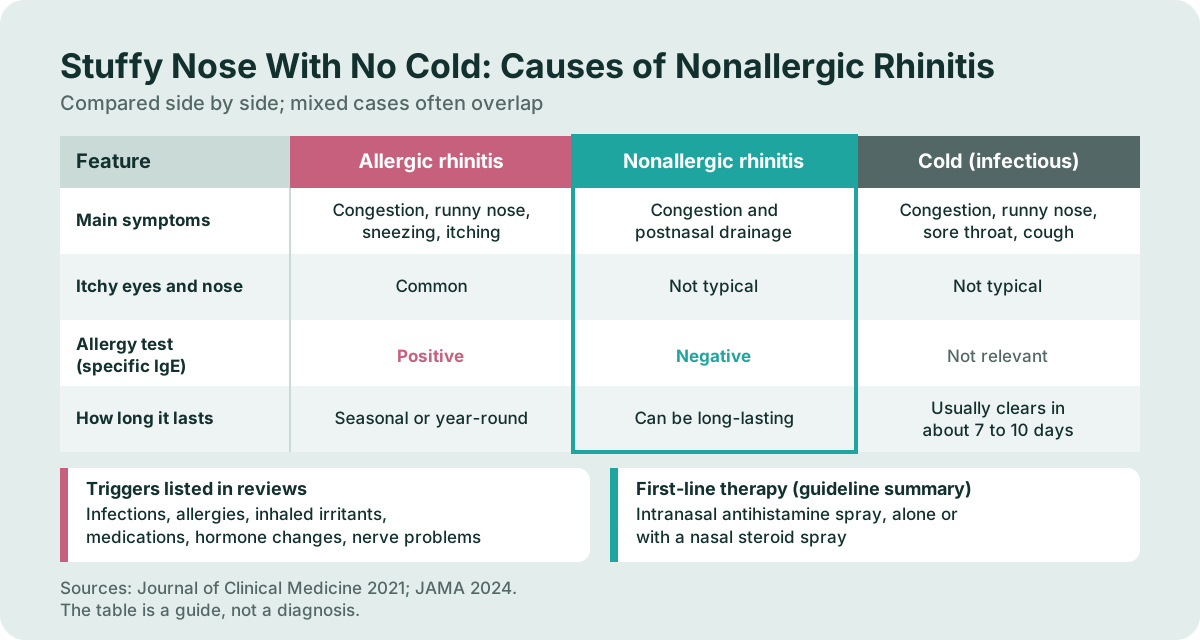
Here is a quick comparison:
| Feature | Allergic rhinitis | Nonallergic rhinitis | Cold (infectious) |
|---|---|---|---|
| Main symptoms | Congestion, runny nose, sneezing, itching | Congestion and postnasal drainage | Congestion, runny nose, sore throat, cough |
| Itchy eyes and nose | Common | Not typical | Not typical |
| Allergy test (specific IgE) | Positive | Negative | Not relevant |
| How long it lasts | Seasonal or year-round | Can be long-lasting | Usually clears in about 7 to 10 days |
The table is a guide, not a diagnosis. Symptoms overlap, and only an exam and testing can sort them out.
What causes a stuffy nose when you are not sick?
The reviews point to several trigger groups. The Journal of Clinical Medicine review lists infections, immediate-type allergic responses, inhaled irritants, medications, hormonal disturbances and neural system dysfunction. Several of these fit nonallergic rhinitis. Here is how they show up in daily life.
Inhaled irritants
Smoke, strong perfumes, cleaning sprays and fumes can make the nasal lining swell. The nose reacts even though no allergy is involved. Dry or very cold air can also irritate the lining, and many people notice congestion when the weather shifts.
Medications
Some drugs can cause nasal swelling as a side effect. Overusing decongestant nasal sprays is a well-known example, because congestion can bounce back when the spray wears off. If a stuffy nose began after starting a new medicine, ask the prescriber or a pharmacist. Never stop a prescribed medicine on your own.
Hormone changes
Hormonal disturbances are on the review's trigger list. Pregnancy is a well-known example of a time when many people feel more nasal stuffiness.
Nerve-driven reactions
The nose is controlled partly by nerves that tell blood vessels and glands when to swell or drip. The review lists neural system dysfunction as a possible trigger. This can explain why some people get a runny or blocked nose from temperature changes or certain foods, with no allergy found.
Hidden allergies or a mix
Sometimes the cause is allergic after all, or both types at once. A negative result on a specific IgE test is what points to the nonallergic type, according to the JAMA review. Mixed cases are common, so a blocked nose can have more than one cause.
Could it be something else, like sinusitis, polyps or a bent septum?
Yes. Rhinitis is only one reason for a blocked nose. A 2019 Spanish review groups the sinonasal conditions linked to asthma into allergic rhinitis, nonallergic rhinitis, and chronic rhinosinusitis with or without nasal polyps. It describes polyps as the condition most closely linked to severe asthma. The authors argue the upper airway should always be checked as part of one "united airway."
Other possibilities include:
- Chronic sinusitis, with congestion and facial pressure lasting more than 12 weeks. See chronic sinusitis symptoms and the 12-week rule.
- Nasal polyps, which are soft swellings inside the nose.
- A deviated septum, where the wall between the nostrils is off-center.
These last two can usually be seen on a nasal exam. A doctor may also order a scan.
Does a stuffy nose affect sleep?
It can. A 2014 review in the Asian Pacific Journal of Allergy and Immunology links rhinitis, especially allergic rhinitis, with obstructive sleep apnea. This is a condition where the airway repeatedly blocks during sleep. The authors describe two routes. Nasal blockage raises airway resistance. Mouth breathing also narrows the throat space. The review notes that treating allergic rhinitis, especially with nasal steroid sprays, improved sleep apnea in prior studies.
This review is mostly about allergic rhinitis, so it cannot be applied directly to nonallergic types. Still, a blocked nose with loud snoring, gasping at night or heavy daytime sleepiness is worth raising with a doctor.
What helps nonallergic rhinitis?
The first step is to find and reduce triggers. Keep away from smoke, strong scents and harsh fumes where you can. Saline sprays or rinses and steady indoor humidity may ease dryness and thick mucus for some people. Rinsing safely matters, so use distilled, boiled-and-cooled or sterile water.
For medical treatment, the JAMA review says first-line therapy for nonallergic rhinitis is an intranasal antihistamine used alone, or together with an intranasal corticosteroid. These are spray medicines, and some need a prescription. The same review notes that some nonallergic symptoms respond less well to nasal corticosteroids alone. This is a good reason to have a doctor pick the plan instead of guessing at the pharmacy.
One limit applies to all of this. The reviews summarize research and guidance. They are not head-to-head trials of everyday home remedies, and they admit that clear guidelines are hard to make because rhinitis has so many forms.
When should you see a doctor?
See a doctor if a stuffy nose lasts more than 10 days without improving, or keeps coming back for weeks. Get care sooner for any of these:
- Blockage on one side only that never changes
- Repeated nosebleeds
- Thick green or yellow mucus with fever and facial pain
- A loss of smell
- Swelling around the eyes or a vision change
- A severe headache or stiff neck
- Loud snoring with pauses in breathing
- A stuffy nose that began after a new medicine
- Congestion that depends on decongestant spray to feel better
A specialist can examine the inside of the nose, order allergy testing and check for polyps or a septum problem. If you live in the Garden State, you can find nose and sinus doctors in New Jersey who evaluate long-lasting congestion.
Common questions
Why is my nose stuffy when I am not sick and have no allergies?
The cause may be nonallergic rhinitis, where the nasal lining swells without an allergy or infection. Reviews list irritants, medications, hormone changes and nerve-driven reactions as triggers. A deviated septum, polyps or chronic sinusitis can also block the nose, so a persistent problem deserves a doctor's exam.
How do I know if it is allergic or nonallergic rhinitis?
Itching of the nose and eyes plus sneezing points toward allergies. Nonallergic rhinitis mainly causes congestion and postnasal drainage. The clearest difference is testing: people with nonallergic rhinitis have negative results for specific IgE allergy tests, according to a 2024 JAMA review. Mixed cases are also common.
What is the first-line medicine for nonallergic rhinitis?
A 2024 JAMA review names an intranasal antihistamine spray as first-line therapy, used alone or with an intranasal corticosteroid spray. Some of these sprays need a prescription. A doctor can choose the right one and check that something else, such as polyps, is not causing the blockage.
Can nonallergic rhinitis go away on its own?
It can come and go depending on triggers such as smoke, weather or strong smells. Avoiding triggers often helps. Because the condition has many forms and no single clear pattern, any congestion lasting weeks should be checked by a doctor rather than waited out.
Sources
- Allergic Rhinitis: A Review. JAMA, 2024
- The linkage of allergic rhinitis and obstructive sleep apnea. Asian Pacific journal of allergy and immunology, 2014
- Asthma, rhinitis, and nasal polyp multimorbidities. Archivos de bronconeumologia, 2019
- Review of Rhinitis: Classification, Types, Pathophysiology. Journal of clinical medicine, 2021
Trusted resources
From our sister sites
NJ Sinus & AllergySinus Pressure From Allergies: Causes and What HelpsAllergies swell the nasal lining and block sinus drainage, which causes pressure. Learn why it happens, what helps, and when to see a doctor in NJ.Coastal SinusChronic Sinusitis: Symptoms, Causes and the 12-Week RuleChronic sinusitis means sinus symptoms lasting 12 weeks or more, plus proof of inflammation. Learn the symptoms, causes, tests and treatment options.Articles are for general information, not medical advice. See a doctor for symptoms that are severe, persistent, or one-sided. Last updated November 15, 2026.